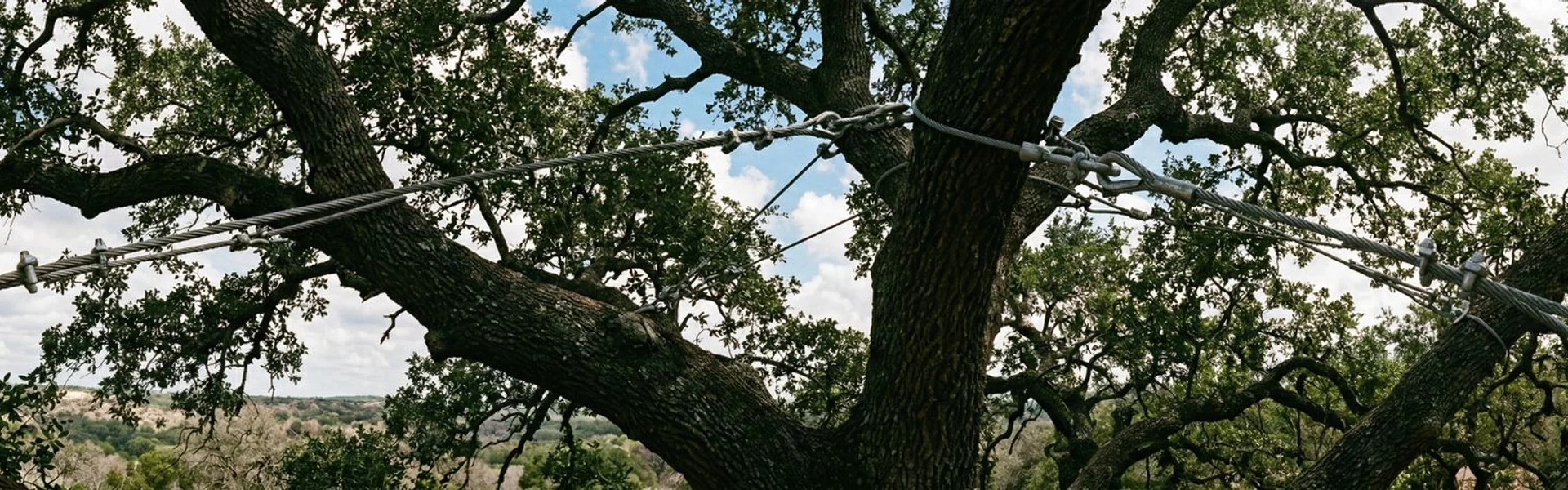
Professional Tree Cabling and Bracing in San Angelo
Professional tree cabling and bracing in San Angelo, TX. Dynamic and static cable systems, brace rods, and co-dominant stem support to prevent storm damage.
What's Included
- Dynamic cabling with synthetic rope systems
- Static steel cable installation for heavy limbs
- Through-rod bracing for split crotches
- Co-dominant stem support and stabilization
- V-crotch included bark repair
- Wind load reduction for West Texas storms
- Annual inspection and hardware assessment
- ANSI A300 compliant support systems
Structural Support Systems for San Angelo’s Trees
West Texas wind is relentless. San Angelo regularly experiences sustained winds above 30 miles per hour and storm gusts that exceed 60 miles per hour. For trees with structural defects like co-dominant stems, included bark unions, or heavy lateral limbs, these wind events create forces that can split trunks, shear off major branches, and cause catastrophic failures that damage homes, vehicles, fences, and power lines.
San Angelo Texas Tree Service Pros installs professional cabling and bracing systems that reinforce structurally compromised trees, allowing them to withstand the wind loads and storm events that are a regular part of life in the Concho Valley. Learn more about how tree cabling and bracing saves trees through structural support. Our certified arborists evaluate each tree’s specific weaknesses and design support systems that address the actual forces at play, not generic one-size-fits-all installations.
When Trees Need Structural Support
Not every tree needs cabling or bracing. These systems are designed for specific structural conditions that create elevated risk of failure. Our arborists assess whether support is warranted based on the type and severity of the defect, the tree’s location relative to targets below, and the wind exposure at the site.
Co-Dominant Stems
Co-dominant stems occur when two or more trunks of roughly equal diameter emerge from the same point on the tree. This is extremely common in live oaks, pecans, and cedar elms throughout San Angelo. When co-dominant stems develop with a narrow V-shaped crotch, bark becomes included in the union rather than forming a strong overlapping collar. This included bark acts as a wedge that weakens the attachment and makes the union prone to splitting under wind or ice load.
Cabling systems installed between co-dominant stems limit the spread between the two leads, reducing the leverage forces that drive splitting. For unions that have already begun to separate, through-rod bracing with threaded steel rods provides rigid reinforcement that holds the stems together mechanically.
Heavy Lateral Limbs
Mature live oaks and pecans in San Angelo often develop massive horizontal limbs that extend 20 to 40 feet from the trunk. These limbs carry enormous weight, and the leverage they exert on their attachment point increases with every foot of extension. A single large live oak limb can weigh several thousand pounds, and when wind adds dynamic loading on top of that static weight, the forces at the branch union become extreme.
Support cables installed between heavy laterals and higher anchor points in the canopy transfer a portion of the load upward, reducing stress on the branch attachment. This is especially important for limbs that extend over roofs, patios, driveways, and other areas where failure would cause significant property damage or injury.
Previous Storm Damage
Trees that have lost major limbs in past storms often develop compensatory growth patterns that create new structural problems. The remaining canopy may become lopsided, putting asymmetric wind loads on the trunk. Wound wood that forms over large pruning cuts or tear-outs may not develop the same structural strength as the original wood. Cabling can stabilize these trees while they redistribute growth and regain structural balance over time.
Our Cabling and Bracing Systems
Dynamic Cabling
Dynamic cabling represents the current best practice in arboricultural support technology. These systems use high-strength synthetic rope or webbing installed in the upper third of the canopy between the stems or limbs that need support. Unlike rigid steel cables, dynamic systems allow the tree to move naturally under normal wind conditions, which encourages the tree to develop stronger reaction wood and improve its own structural capacity.
When wind forces exceed the tree’s natural strength, the dynamic cable engages and limits further movement, preventing the dangerous over-extension that leads to failure. This approach treats the cable as a safety net rather than a permanent crutch, which is better for the tree’s long-term health and structural development.
We use Cobra dynamic cable systems and similar engineered products that are specifically designed for tree support applications. These systems include built-in shock absorbers that dampen sudden loads and expand with the tree’s growth so they do not girdle branches over time.
Static Steel Cabling
For trees with severe structural defects, heavy limbs over high-value targets, or situations where rigid support is necessary, we install traditional static steel cable systems. These use extra-high-strength steel cable with forged eye bolts and lag hardware installed through the stems or branches.
Static cables provide maximum load capacity and are the appropriate choice when the tree cannot be allowed any additional spread at the defect location. We size hardware based on the estimated failure load of the defect and the wind forces specific to the installation site, with appropriate safety factors built into the design.
Through-Rod Bracing
Brace rods are threaded steel rods installed horizontally through co-dominant stems, split crotches, or cracked trunks to provide rigid mechanical connection. Unlike cables that work in tension to limit spread, brace rods resist the shear and separation forces that drive splits apart.
We typically install brace rods in combination with cables to create a comprehensive support system. The rods hold the split together while the cables above limit the dynamic forces that caused the split in the first place. All rod installations use proper washers and nuts sized for the hardware, and we countersink attachment points to prevent bark damage.
V-Crotch Repair
V-crotch unions with included bark are one of the most common structural defects in San Angelo’s urban trees. When caught early, before significant splitting has occurred, these can be reinforced with a combination of dynamic cabling and, if needed, brace rods. For unions where separation has already begun, we assess the extent of the crack and determine whether the tree can be stabilized or whether the risk of continued failure makes removal the responsible recommendation.
Wind Damage Prevention for West Texas Properties
San Angelo’s location on the western edge of the Texas Hill Country exposes trees to weather patterns that generate significant wind events throughout the year. Spring thunderstorms bring damaging straight-line winds and occasional tornadoes. Summer convective storms produce intense microbursts. Fall and winter cold fronts drive sustained northerly winds that stress trees for hours at a time.
Property owners who invest in cabling and bracing for structurally compromised trees dramatically reduce their exposure to storm damage. A single large limb falling on a roof can cause tens of thousands of dollars in damage, and a trunk failure can total a vehicle or destroy a fence line. The cost of a properly designed support system is a small fraction of the potential loss from an unaddressed structural defect.
Annual Inspection and Maintenance
Every cabling and bracing system we install comes with a recommended annual inspection schedule. During these inspections, our arborist checks cable tension, hardware condition, tree growth around attachment points, and the overall structural condition of the supported defect. Trees grow and change constantly, and a system that was perfectly configured at installation may need adjustment as the tree adds wood and shifts its weight distribution.
We also assess whether the tree has responded to the support system by developing stronger wood at the defect location. In some cases, particularly with dynamic cabling on younger trees, the tree’s own structural improvement may eventually allow the system to be removed.
Schedule a Structural Assessment
If you have trees with split crotches, heavy leaning limbs, co-dominant stems, or previous storm damage, contact San Angelo Texas Tree Service Pros for a structural assessment. Our certified arborists will evaluate the risk, explain your options, and design a support system that protects your property and preserves your trees. We serve San Angelo, Grape Creek, Wall, Christoval, and communities throughout Tom Green County and the Concho Valley.
Why Choose Us for Cabling & Bracing
Engineered for West Texas Wind
We design every cabling system with San Angelo's sustained winds and severe storm events in mind, using hardware and configurations rated for the forces your trees actually face.
Save Trees Others Would Remove
Many structurally compromised trees can be preserved with proper cabling and bracing, saving you the cost of removal and the decades it takes to replace a mature tree.
ANSI A300 Supplemental Support Standards
Every system we install meets the American National Standards Institute guidelines for tree support, ensuring proper hardware, placement, and load distribution.
Modern Dynamic Systems
We use the latest dynamic cabling technology that allows natural tree movement while limiting dangerous over-extension, promoting stronger wood development over time.
Pricing
$300 - $1200 per system
Free estimates. Pricing varies by project scope.
Why Trust Us
- ISA Certified Arborist
- Fully Licensed & Insured
- 22+ Years Experience
- 5.0 Rating (100+ Reviews)
Related Services
Our Cabling & Bracing Process
Structural Assessment
Our certified arborist evaluates the tree's architecture, identifies structural weaknesses, and determines whether cabling, bracing, or both are the appropriate solution.
System Design
We design the support system based on the tree's species, size, defect location, and wind exposure, selecting the right hardware and placement for maximum effectiveness.
Professional Installation
Our climbers install cables and braces at the correct heights and angles following ANSI A300 supplemental support standards, using hardware rated for the load requirements.
Documentation & Inspection Schedule
We document the installation with photos and specifications, then establish an annual inspection schedule to verify hardware integrity and tree response.
Ongoing Monitoring
Annual inspections check cable tension, hardware condition, and tree growth around attachment points. We adjust or replace components as needed to maintain system performance.
Cabling & Bracing Gallery
What Clients Say About Our Cabling & Bracing
“Our 80-year-old pecan had a massive split forming in the main crotch. They installed brace rods and cables and saved the tree. That was three years ago and it has been through multiple storms since with no issues. These guys know their craft.”
Robert Kessler
“Two companies told us to remove our heritage live oak because of the co-dominant trunks. San Angelo Tree Service Pros installed a cabling system and the tree is thriving. They saved a tree that would have cost us shade and property value.”
Linda Vasquez
Cabling & Bracing FAQs
Static cabling uses steel cables with fixed attachment hardware that restricts movement between supported limbs. Dynamic cabling uses synthetic rope or webbing systems that allow the tree to move naturally in moderate winds while providing a safety net during extreme loading events. Dynamic systems are generally preferred for younger or moderately compromised trees because they encourage the tree to develop stronger reaction wood. Static systems are used when rigid support is needed for severe defects or heavy limbs over high-value targets.
In many cases, yes. If the split has not progressed through the entire union and the wood on both sides is still structurally sound, a combination of through-rod bracing and cabling can stabilize the tree and prevent further separation. Our arborist assesses the extent of the damage to determine whether repair is feasible or whether the risk is too great and removal is the safer option.
Steel cables and through-rod braces typically last 15 to 25 years depending on the hardware grade and environmental conditions. Dynamic synthetic systems have a lifespan of 8 to 12 years before the rope degrades from UV exposure and needs replacement. All systems require annual inspection to check hardware integrity, cable tension, and tree growth around attachment points.
Properly installed cabling causes minimal harm to the tree. Modern attachment hardware is designed to distribute loads across the wood without creating stress concentration points. The small drill holes used for through-bolt anchors and brace rods compartmentalize and heal over time. The structural benefit of preventing limb failure far outweighs the minor wound created during installation.
Modern dynamic cable systems typically last 7 to 10 years and should be inspected annually. Static steel cables and brace rods can last the life of the tree with proper maintenance. Our arborists include a recommended inspection schedule with every installation.
Ready for Professional Cabling & Bracing?
Contact our ISA Certified Arborist team for a free estimate on cabling & bracing in San Angelo and Tom Green County.