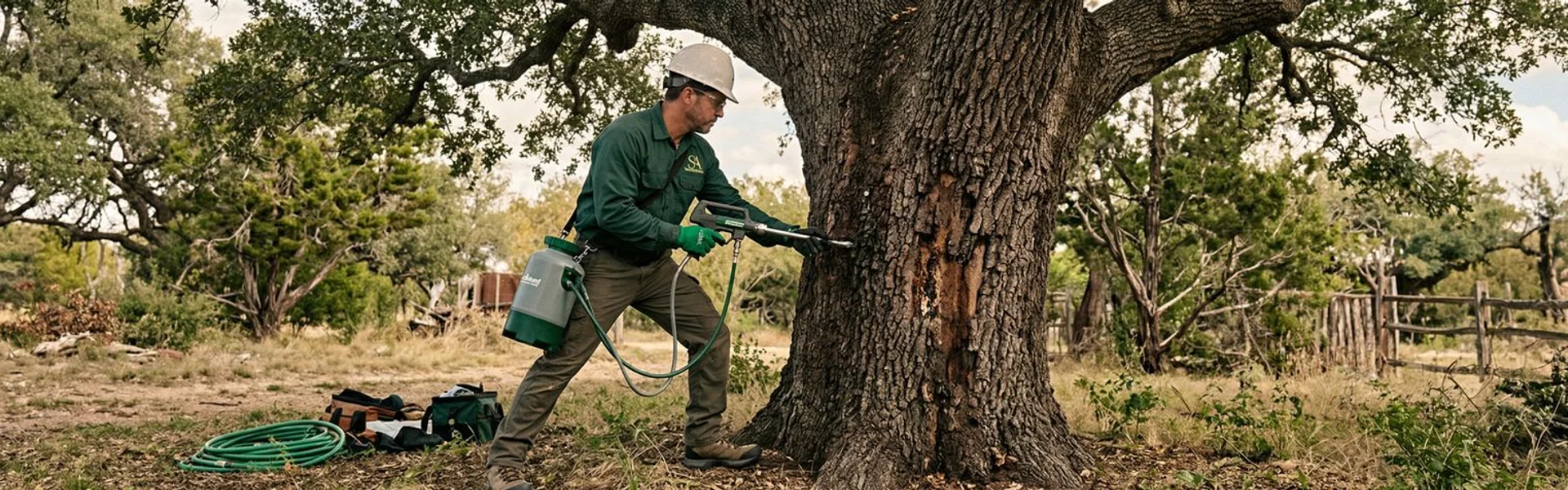
Trusted Tree Insect and Disease Control in San Angelo
Professional insect and disease control for trees in San Angelo, TX. TDA licensed applicators treating oak wilt, bacterial leaf scorch, bagworms, borers, and hypoxylon canker.
What's Included
- Oak wilt diagnosis and propiconazole trunk injection
- Bacterial leaf scorch identification and management
- Bagworm and webworm treatment programs
- Borer detection and systemic insecticide application
- Hypoxylon canker assessment and mitigation
- Integrated Pest Management (IPM) strategies
- TDA licensed commercial applicators
- Preventive treatment schedules for high-risk species
Expert Tree Insect and Disease Control in the Concho Valley
Trees across San Angelo face a constant battle against insects and diseases that thrive in the West Texas climate. The combination of prolonged drought stress, alkaline caliche soils, and extreme summer heat weakens trees and creates ideal conditions for the common tree diseases in Tom Green County to take hold. San Angelo Texas Tree Service Pros provides professional diagnosis and treatment that stops infestations and infections before they kill your trees.
Our certified arborists and TDA licensed applicators have years of experience identifying and treating the specific pests and diseases that affect live oaks, pecans, cedar elms, mesquite, and other species throughout Tom Green County. We do not guess at treatments. Every program begins with a thorough inspection and accurate diagnosis, because applying the wrong product for the wrong problem wastes your money and delays effective care while the tree continues to decline.
Common Tree Diseases in San Angelo
Oak Wilt
Oak wilt is the most devastating tree disease in Texas, and San Angelo’s extensive live oak population is at risk. Knowing how to identify oak wilt in San Angelo is critical for early intervention. Caused by the fungal pathogen Ceratocystis fagacearum, oak wilt kills red oaks within weeks and can destroy live oaks within months. The fungus blocks the tree’s water-conducting vessels, causing rapid wilting and characteristic veinal necrosis on leaves.
In live oaks, the disease spreads primarily through interconnected root systems. A single infected tree can transmit the fungus to every live oak within a connected root network, sometimes killing entire groves. We combat oak wilt with propiconazole trunk injections delivered directly into the sapwood using macro-infusion techniques. For properties with multiple live oaks, we also recommend trenching to sever root grafts and create barriers that stop underground transmission.
Prevention is critical. We advise San Angelo property owners to avoid pruning live oaks between February and June when nitidulid beetles are most active. If pruning is unavoidable, all wounds must be sealed immediately with wound paint to prevent beetle access.
Bacterial Leaf Scorch
Bacterial leaf scorch is caused by the bacterium Xylella fastidiosa and has become increasingly common in San Angelo’s live oaks and sycamores. Symptoms include marginal leaf browning that progresses inward, premature leaf drop, and a distinctive yellow border between green and scorched leaf tissue. The disease is spread by xylem-feeding insects like leafhoppers and sharpshooters.
There is no cure for bacterial leaf scorch, but we manage infected trees with antibiotic trunk injections, stress reduction through proper watering and fertilization, and monitoring to slow disease progression. Many infected trees continue to provide shade and value for years under a good management program.
Hypoxylon Canker
Hypoxylon canker is an opportunistic fungal disease that attacks trees already weakened by drought, construction damage, or root loss. It is extremely common in San Angelo, especially during and after extended dry periods. The fungus lives beneath the bark of healthy trees without causing harm, but when the tree becomes severely stressed, it erupts through the bark as dark, crusty fungal mats.
Once hypoxylon canker becomes visible on the trunk or major limbs, the affected wood is already dead and cannot be saved. However, early intervention to reduce stress through deep-root watering, fertilization, and addressing root damage can prevent the fungus from advancing in trees that show initial signs of decline. Our arborists assess whether affected trees can be managed or whether removal is the safest option.
Common Tree Insects in San Angelo
Bagworms
Bagworms are among the most destructive caterpillar pests in the Concho Valley. They attack cedar elms, bald cypress, junipers, and many ornamental species. The larvae construct distinctive spindle-shaped bags from silk and plant material, feeding voraciously on foliage throughout the summer. A severe infestation can completely defoliate a tree in a single season, and repeated defoliation often kills the tree.
We treat bagworms with targeted insecticide applications timed to the larval hatch window in mid-June. Treating when larvae are small and actively feeding on leaf surfaces produces the best results. Bacillus thuringiensis (Bt) and spinosad are effective biological options for early-stage larvae, while synthetic products may be needed for larger caterpillars or heavy infestations.
Borers
Several species of wood-boring beetles and clearwing moths attack stressed trees in San Angelo. Flatheaded appletree borers target drought-stressed live oaks and pecans, tunneling beneath the bark and severing the cambium layer. Peach tree borers attack ornamental and fruit trees. Emerald ash borer, while not yet confirmed in Tom Green County, is moving westward across Texas and threatens the area’s ash trees.
Borer treatment involves systemic insecticides applied as trunk injections or soil drenches. The active ingredient imidacloprid or dinotefuran moves through the tree’s vascular system, killing larvae as they feed beneath the bark. For high-value trees in areas where borers are active, we recommend preventive treatments applied annually before beetle flight season.
Scale Insects
Obscure scale, lecanium scale, and other scale insects are common on live oaks and pecans in San Angelo. Heavy infestations weaken trees by extracting sap, and scale insects excrete honeydew that promotes sooty mold growth on leaves and surfaces below the canopy. We control scale with horticultural oil applications timed to the crawler stage when the insects are most vulnerable, supplemented by systemic treatments for severe infestations.
Our Integrated Pest Management Approach
San Angelo Texas Tree Service Pros follows Integrated Pest Management principles for every insect and disease program we design. IPM is not a single treatment method but a systematic approach that combines multiple strategies to manage pests effectively while minimizing chemical inputs and environmental impact.
Cultural Controls
Many insect and disease problems begin with poor cultural practices. Trees planted in the wrong location, watered incorrectly, or damaged by construction are far more susceptible to attack. We assess site conditions and recommend changes to watering schedules, mulching practices, and soil management that reduce stress and build natural resistance.
Biological Controls
When feasible, we encourage natural predators and parasites that keep pest populations in check. Lady beetles, lacewings, and parasitic wasps all play roles in controlling aphids, scale, and caterpillar populations in San Angelo landscapes. Our treatment programs are designed to preserve these beneficial insects while targeting the pest species causing damage.
Targeted Chemical Applications
When chemical treatment is necessary, we select the most effective product for the specific pest, apply it using the most targeted method available, and time applications to the pest’s most vulnerable life stage. Trunk injection is our preferred method for many tree diseases and systemic insect treatments because it delivers product directly into the tree without any external spray drift.
Trunk Injection Technology
Trunk injection has transformed tree pest and disease management. Rather than spraying chemicals over the canopy surface, we place small injection ports into the tree’s sapwood and deliver fungicides, insecticides, or nutrients directly into the vascular system. The tree’s own transpiration stream distributes the product throughout the canopy, roots, and growing tissues.
This method offers several advantages for San Angelo property owners. There is no spray drift to contact people, pets, or non-target plants. Product is not washed off by rain or irrigation. Dosing is precise and calibrated to the tree’s trunk diameter. And because the product moves systemically, it reaches bark beetles, borers, and other pests that surface sprays cannot contact.
Protect Your Trees Before Problems Escalate
Tree diseases and insect infestations rarely improve on their own. Most get progressively worse without intervention, and many reach a point where the tree cannot be saved. If you notice unusual leaf discoloration, premature leaf drop, bore holes, webbing, or any other signs of decline, contact San Angelo Texas Tree Service Pros for a diagnostic inspection. We serve San Angelo, Grape Creek, Wall, Christoval, Ballinger, and communities across Tom Green County and the Concho Valley.
Why Choose Us for Insect & Disease
TDA Licensed Applicators
Our technicians hold Texas Department of Agriculture commercial applicator licenses, ensuring all chemical treatments meet state safety and regulatory standards.
Accurate Diagnosis First
We never treat blindly. Every program begins with a thorough inspection and, when necessary, laboratory confirmation to ensure we target the actual problem.
IPM-Based Approach
We use Integrated Pest Management principles that combine cultural practices, biological controls, and targeted chemical applications to minimize environmental impact.
Local Species Expertise
We understand the specific pests and diseases that affect live oaks, pecans, cedar elms, and mesquite in the Concho Valley's semi-arid climate.
Pricing
$200 - $800 per treatment
Free estimates. Pricing varies by project scope.
Why Trust Us
- ISA Certified Arborist
- Fully Licensed & Insured
- 22+ Years Experience
- 5.0 Rating (100+ Reviews)
Related Services
Our Insect & Disease Process
Diagnostic Inspection
Our certified arborist inspects the tree's canopy, bark, roots, and surrounding soil to identify the specific insect or pathogen causing decline.
Lab Confirmation & Treatment Plan
When needed, we collect samples for laboratory analysis. We then develop a targeted treatment plan based on confirmed diagnosis, tree species, and severity.
Treatment Application
Our TDA licensed applicators deliver treatments via trunk injection, soil drench, foliar spray, or bark application depending on the pest or disease identified.
Monitoring & Follow-Up
We schedule follow-up visits to assess treatment effectiveness, adjust applications if needed, and recommend ongoing preventive care.
Insect & Disease Gallery
What Clients Say About Our Insect & Disease
“Our two large live oaks were losing leaves and we feared oak wilt. The arborist diagnosed bacterial leaf scorch, started a management plan, and both trees have stabilized. Very knowledgeable and honest about what could be done.”
Patricia Morales
“Bagworms destroyed our cedar elms two years in a row before we called these guys. They set up a preventive spray schedule and we have not had a single infestation since. Worth every penny.”
David Kirchner
Insect & Disease FAQs
Oak wilt is a lethal fungal disease caused by Ceratocystis fagacearum that kills live oaks and red oaks rapidly. It has been confirmed in counties across central Texas and poses a real threat to San Angelo's live oak population. The fungus spreads through root grafts between nearby oaks and via sap-feeding nitidulid beetles attracted to fresh wounds. We treat confirmed cases with propiconazole trunk injections and install root barriers to stop underground spread.
Insect damage typically shows physical evidence like bore holes, frass, webbing, chewed leaves, or visible larvae. Disease symptoms include discoloration, wilting, cankers, fungal fruiting bodies, and premature leaf drop. Many symptoms overlap, which is why professional diagnosis matters. Our arborists are trained to distinguish between insect, fungal, bacterial, and abiotic causes of tree decline.
We prioritize targeted application methods like trunk injection that place product directly inside the tree's vascular system, keeping chemicals off surfaces where people and pets contact them. When foliar sprays or soil treatments are necessary, we use EPA-registered products at label rates and follow all re-entry interval guidelines. We always inform you of any precautions before treatment.
Bagworms hatch in late May to early June in the San Angelo area. The most effective treatment window is when larvae are small, typically mid-June through early July. Treating early while the caterpillars are actively feeding and exposed gives the best results. By late summer, bagworms seal their bags and become much harder to control with insecticides.
If caught early, propiconazole trunk injections can significantly improve survival rates for live oaks with oak wilt. Red oaks are more difficult to save once symptoms appear. Early detection through regular inspections is your best defense.
Ready for Professional Insect & Disease?
Contact our ISA Certified Arborist team for a free estimate on insect & disease in San Angelo and Tom Green County.