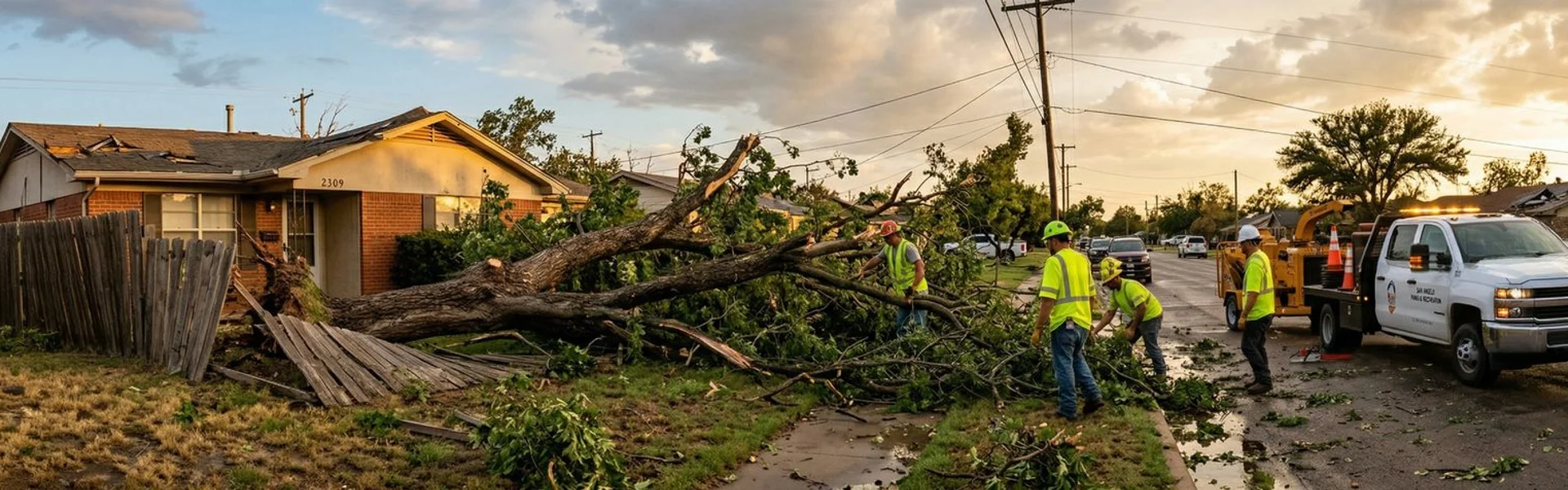
24/7 Emergency Tree Removal in San Angelo TX
24/7 emergency tree services in San Angelo, TX. Rapid response for storm damage, fallen trees on structures, and hazardous tree situations throughout the Concho Valley.
What's Included
- 24/7 emergency response throughout San Angelo
- Rapid dispatch within 60 minutes for critical situations
- Fallen tree removal from homes and structures
- Storm damage assessment and debris clearing
- Coordination with utility companies for power line issues
- Temporary property protection and tarping
- Insurance documentation and photo evidence
- Post-storm property-wide tree assessments
24/7 Emergency Tree Response for San Angelo and West Texas
When a tree crashes through your roof at midnight, blocks your driveway during a thunderstorm, or leans dangerously toward your home after high winds, knowing what to do when a tree falls on your property can make all the difference. You need a crew that answers the phone and shows up fast. San Angelo Texas Tree Service Pros provides true around-the-clock emergency tree services for homeowners and businesses throughout San Angelo, Tom Green County, and the Concho Valley.
Our emergency response is not a voicemail box that gets checked in the morning. A live dispatcher answers our emergency line 24 hours a day, 7 days a week, 365 days a year. We maintain dedicated on-call crews with trucks loaded and ready to roll, because tree emergencies do not wait for business hours and neither do we.
West Texas Weather Creates Real Tree Emergencies
San Angelo sits at the intersection of weather systems that produce some of the most intense storms in Texas. Understanding the threats our region faces explains why emergency tree services are not optional but essential for Concho Valley property owners.
Severe Thunderstorms
From April through October, the Concho Valley experiences powerful thunderstorms that produce damaging straight-line winds, large hail, and heavy downpours. The National Weather Service classifies San Angelo as a moderate to high risk area for severe convective weather. Winds during these events routinely exceed 60 miles per hour and can reach 80 to 100 miles per hour in the strongest cells. Trees that have not been properly maintained are especially vulnerable, but even healthy trees can fail under extreme wind loading.
Ice Storms
While less frequent than thunderstorms, West Texas ice storms can be devastating to trees. When freezing rain coats branches with a quarter inch or more of ice, the added weight can exceed the structural capacity of limbs and entire canopies. The February 2021 winter storm demonstrated this dramatically across San Angelo, leaving thousands of broken and fallen trees throughout the city. Ice damage is particularly dangerous because it often happens at night when temperatures drop, and homeowners wake to find large limbs or whole trees on their roofs, vehicles, and fences.
Drought Stress and Sudden Failure
San Angelo’s long, hot summers create chronic drought stress that weakens trees over time. When roots die back during extended dry periods, the tree’s anchoring system degrades. A tree that appeared stable for years can suddenly topple during a moderate wind event because its compromised root plate can no longer hold. This type of failure is insidious because the external appearance of the tree may give no warning before it falls.
Microbursts and Tornadoes
The Concho Valley occasionally experiences microbursts and tornadoes that concentrate destructive wind energy in small areas. These events can snap, uproot, or twist large trees in seconds, leaving a chaotic tangle of broken wood, power lines, and structural debris that requires immediate professional response.
What Qualifies as a Tree Emergency?
Our dispatchers prioritize calls based on the level of threat to people, structures, and access. Here is how we categorize tree emergencies:
Immediate Life-Safety Threats
A tree or large limb that has fallen on an occupied structure, is resting on power lines, or is blocking emergency vehicle access receives our highest priority response. We dispatch immediately with the goal of having a crew on-site within 60 minutes. If power lines are involved, we coordinate with AEP Texas before beginning work to ensure the lines are de-energized.
Structural Damage in Progress
Trees that have partially fallen onto a home, garage, or commercial building but have not fully completed their fall are actively dangerous. Additional wind, rain, or the tree’s own shifting weight can cause secondary collapse at any time. Our crew stabilizes these situations by securing the tree with rigging or removing the most critical sections first, then completing the full removal once the immediate danger is controlled.
Access Blockage
Fallen trees across driveways, private roads, and parking lots prevent people from getting in and out of their properties. During widespread storm events, access blockage can also delay first responders. We prioritize clearing access routes so that emergency services and residents can move freely.
Hazardous Lean or Partial Failure
A tree that has developed a sudden lean, lost a major scaffold limb, or shows signs of root plate lifting is not yet down but could fall at any time. These situations require prompt assessment by our arborist to determine whether the tree can be stabilized or must be removed immediately. We recommend keeping people, vehicles, and pets out of the potential fall zone until our crew arrives.
Our Emergency Response Protocol
When you call our emergency line, here is exactly what happens:
Our dispatcher gathers critical information: your address, the nature of the emergency, whether anyone is injured, whether power lines are involved, and the best access route to the tree. Based on this information, they categorize the call and dispatch the appropriate crew.
The on-call crew loads their truck with chainsaws of multiple sizes, rigging ropes and hardware, emergency lighting for night operations, tarps for temporary roof protection, and personal protective equipment. They depart for your location immediately after the dispatch call.
Upon arrival, the crew leader assesses the scene and establishes a safe work zone. If power lines are involved and not yet de-energized, the crew maintains a safe distance and contacts AEP Texas for emergency disconnect. Once the scene is safe to enter, the crew begins hazard mitigation by removing the most dangerous elements first, whether that is a limb resting on your roof, a trunk section blocking egress, or a hanging branch that could drop on someone below.
After the immediate hazard is neutralized, the crew completes the full removal and cleanup. They document the scene with photographs from multiple angles, noting the species, approximate size, failure point, and damage caused. This documentation package is invaluable for your insurance claim and is provided to you at no additional charge.
Insurance Claims and Documentation
Filing an insurance claim for storm-damaged trees in Texas is stressful, and poor documentation can result in denied or reduced claims. Our crews are trained to capture the evidence your insurance company needs:
- Pre-removal photographs showing the tree’s position, the damage to structures, and the failure point
- Species identification and approximate age and size of the tree
- Cause of failure assessment noting weather conditions, structural defects, or disease that contributed to the event
- Detailed invoice breaking down labor, equipment, and disposal costs in the format insurance adjusters require
We have worked with every major insurance carrier operating in Tom Green County and understand what documentation they expect. If your adjuster needs additional information or wants to inspect the site before full removal, we coordinate directly with them to keep your claim on track.
Post-Storm Property Assessments
After a significant storm event, the trees that fell are not the only concern. Other trees on your property may have sustained hidden damage that leaves them vulnerable to failure in the next weather event. Our arborists offer post-storm property assessments where they walk your entire property, inspect every tree for cracked limbs, split crotches, root plate movement, and canopy damage, and provide a prioritized report of recommended actions.
This assessment can prevent a second emergency by identifying damaged trees before they fail. Many of our San Angelo clients schedule these assessments after every significant storm as a proactive risk management practice.
Be Prepared Before Storm Season
While our emergency response is available year-round, the best defense against tree emergencies is proactive maintenance. We recommend scheduling a pre-storm season inspection in early spring to identify and address vulnerable trees, deadwood, and structural weaknesses before severe weather arrives. Combined with regular pruning on a three- to five-year cycle, proactive care dramatically reduces the likelihood that you will need our emergency services at all.
Contact San Angelo Texas Tree Service Pros any time, day or night, at our 24/7 emergency line. We serve San Angelo, Grape Creek, Wall, Christoval, Ballinger, and communities across the Concho Valley and Tom Green County.
Why Choose Us for Emergency Services
True 24/7 Availability
Our emergency line is answered by a real person at any hour. We maintain on-call crews nights, weekends, and holidays specifically for storm events and urgent situations.
60-Minute Response Goal
For critical emergencies involving threats to safety or occupied structures, we target 60-minute response times anywhere in the San Angelo metro area.
Insurance Claim Support
We photograph and document all damage, provide detailed invoices, and work directly with your insurance adjuster to streamline the claims process.
Storm Season Preparedness
Our crews pre-stage equipment before forecasted severe weather so we can respond immediately when storms move through the Concho Valley.
Why Trust Us
- ISA Certified Arborist
- Fully Licensed & Insured
- 22+ Years Experience
- 5.0 Rating (100+ Reviews)
Related Services
Our Emergency Services Process
Emergency Call Assessment
Our dispatcher evaluates the urgency of your situation by phone, prioritizing threats to life, structures, and access routes.
Rapid Dispatch
A crew with chainsaws, rigging gear, and emergency lighting is dispatched to your location, typically arriving within 60 minutes.
Hazard Stabilization
We secure the scene, remove immediate dangers, and stabilize any partially fallen trees to prevent further damage to your property.
Complete Removal & Cleanup
Once the area is safe, we complete the removal, clear all debris, and document the damage for your insurance claim.
Emergency Services Gallery
What Clients Say About Our Emergency Services
“A huge live oak split during a thunderstorm at 2 AM and landed on our roof. They had a crew here within 45 minutes. They removed the tree, tarped the roof, and had the debris cleared by morning. Saved us from so much more damage.”
Angela Reyes
“After the ice storm last winter, we had three trees down across our property including one on our fence and one blocking the driveway. They prioritized us and had everything cleared within a day. The insurance paperwork they provided was incredibly thorough.”
Mark Stevenson
Emergency Services FAQs
For critical emergencies where a tree has fallen on an occupied structure, is blocking emergency access, or poses an imminent threat to safety, we target a 60-minute response time within the San Angelo metro area. During widespread storm events with high call volume, we triage calls by severity and respond to life-safety situations first.
Most homeowner insurance policies cover tree removal when the tree has damaged a covered structure such as your home, garage, fence, or vehicle. Trees that fall in open yard areas without hitting a structure may not be covered. We document everything thoroughly and can work directly with your insurance adjuster to support your claim.
First, ensure everyone is safe and evacuate the affected area of the home if there is structural concern. Do not attempt to move the tree yourself. Call us immediately at our 24/7 emergency line. Avoid the area near downed power lines. We will dispatch a crew to safely remove the tree and can provide temporary tarping to protect the opening from weather.
Emergency and after-hours calls do carry a premium compared to scheduled daytime work due to the overtime labor, specialized equipment staging, and immediate response commitment involved. However, our pricing remains competitive and transparent. We provide a cost estimate before beginning work whenever the situation allows.
Most homeowners insurance policies in Texas cover tree removal when a tree falls on a structure, blocks a driveway, or damages property. We provide detailed documentation including photographs and a cause-of-failure assessment to support your claim.
Ready for Professional Emergency Services?
Contact our ISA Certified Arborist team for a free estimate on emergency services in San Angelo and Tom Green County.