Tree Trimming for Power Line Clearance in San Angelo
Learn about safe tree trimming near power lines in San Angelo. Understand utility company responsibilities, homeowner obligations, directional pruning techniques, and when to call a certified arborist.
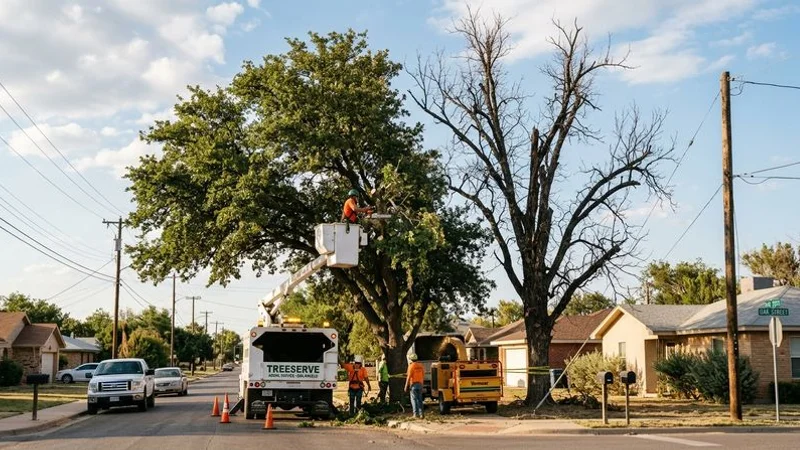
You already know that mixing high West Texas winds with overgrown branches is a fast track to neighborhood power outages. The service drop running directly to your house often serves as the most overlooked hazard on a property. People assume the utility company handles every branch, but that simply is not the case.
Our team at San Angelo Texas Tree Service Pros handles these specific safety hazards daily.
Let’s look at the hard data behind the risks and clarify who is actually responsible for which lines. Securing proper Tree Trimming for Power Line Clearance in San Angelo protects your property from massive financial liabilities.
Why Trees Near Power Lines Are So Dangerous
Power lines in San Angelo carry anywhere from 120 volts on secondary service drops to over 7,200 volts on primary distribution lines. Even the lower-voltage secondary lines can deliver a fatal shock. We constantly remind homeowners that electricity travels easily through a branch to electrify fences and irrigation systems.
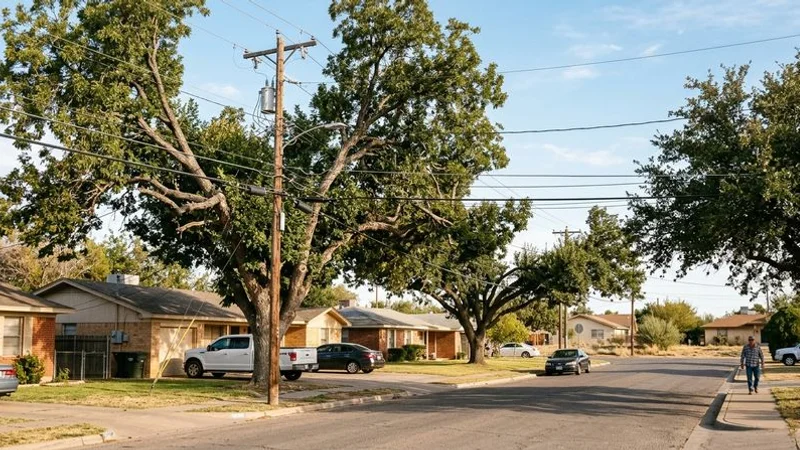
The Texas A&M Forest Service reported in 2024 that power lines caused over 1,300 fires in the Panhandle region alone since 2006. These specific electrical incidents burned roughly 1.4 million acres of land. Our crews know how quickly a single electrical arc ignites dry West Texas brush.
This exact mechanism ignited the historic 2024 Smokehouse Creek Fire before it destroyed over a million acres. A simple residential property mistake sparks catastrophes in seconds.
- Direct Electrocution: Touching an energized branch often proves fatal.
- Widespread Wildfires: Arcing wires easily ignite dead vegetation on the ground.
- Neighborhood Outages: A single downed line cuts power to hundreds of nearby homes.
- Property Destruction: Electrified fences and ruined irrigation controllers cost thousands to replace.
Utility Company vs. Homeowner Responsibilities
Clarifying who pays for the required maintenance saves you time and frustration. The answer strictly depends on which cables run through the canopy. We break this down into two distinct categories for property owners in Tom Green County.
AEP Texas Responsibilities
AEP Texas serves as the primary electric utility for the area. They hold legal responsibility for maintaining clearance around primary distribution and transmission cables. Our arborists often see them utilize specialized contractors to manage vegetation near these high-voltage zones.
Following ANSI 300 Pruning Standards, AEP mandates a 15-foot minimum clearance from primary cables for fast-growing species like Hackberry and Ash trees. Their crews prioritize neighborhood reliability and grid safety over the visual appeal of your landscaping.
Homeowner Responsibilities
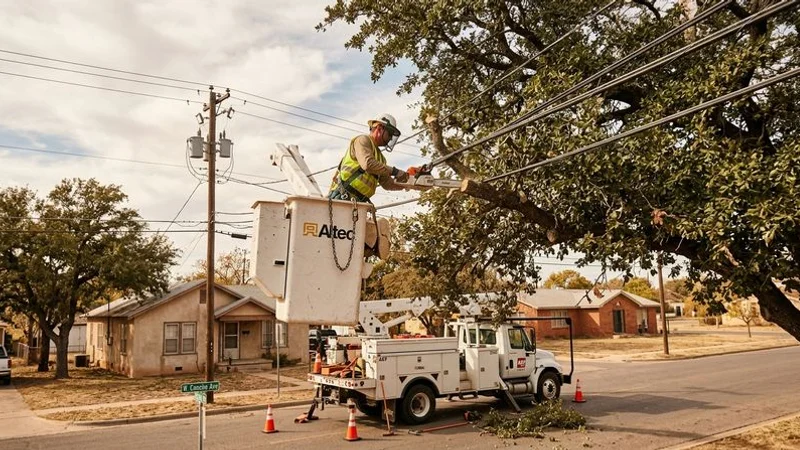
Property owners hold complete responsibility for the secondary service drop. This specific lower line runs directly from the utility pole to your home. We warn clients that repairing torn service drops often results in a steep bill from an electrician.
Neglecting branches that rub against this line can easily tear the connection away from your house during a storm. You must handle all other yard maintenance that does not directly threaten utility-owned infrastructure.
Directional Tree Trimming for Power Line Clearance in San Angelo
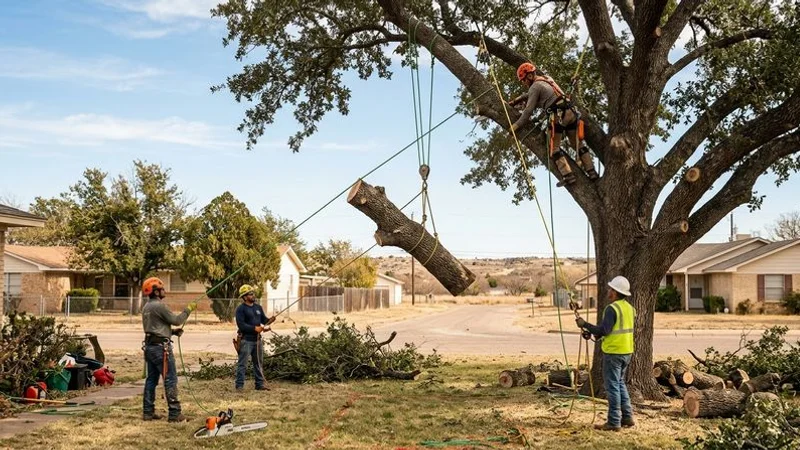
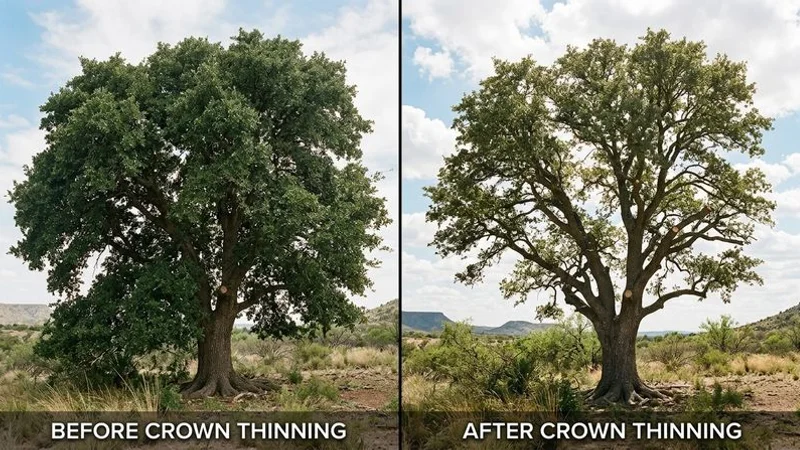
Professional tree trimming operations rely on a targeted technique known as directional pruning. This method directly adheres to ANSI A300 industry standards. We selectively remove only the wood growing directly into the hazard zone.
How Directional Pruning Works
Arborists make precise reduction cuts at the branch collar to preserve the structural integrity of the wood. Lateral limbs growing away from the cables remain intact to encourage the canopy to shift its natural shape. Our methodology ensures the plant stays healthy and grows safely away from danger for several years.
The carefully executed cuts heal quickly without inviting decay into the main trunk. This creates lasting safety without sacrificing the aesthetic value of your property.
Why Topping Is Never the Answer
Amateurs frequently resort to a highly damaging practice called topping. This obsolete technique involves chopping off the entire upper crown in a flat cut. We strongly advise against this because it destroys the natural defense systems of the plant.
The canopy immediately responds by pushing out rapid, weakly attached shoots known as water sprouts. These specific water sprouts grow back approaching the power lines much faster than the original wood did. Topped vegetation in San Angelo frequently suffers from extreme drought stress and sunscald on the newly exposed bark.
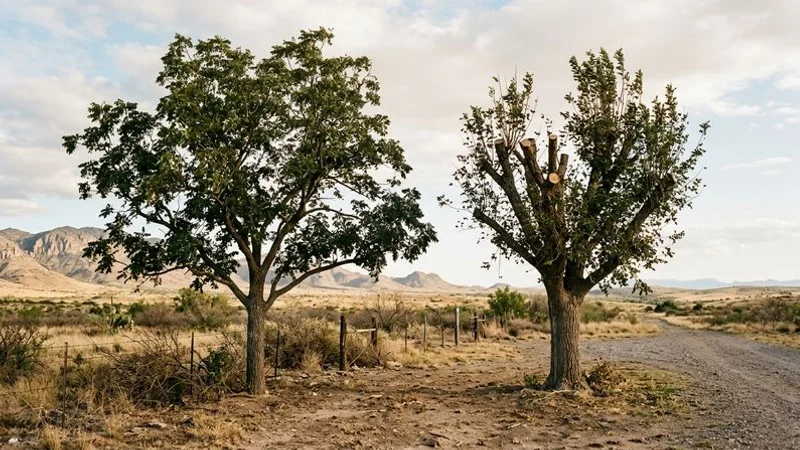
| Feature | Directional Pruning | Tree Topping |
|---|---|---|
| Industry Standard | Approved by ANSI A300 | Condemned by experts |
| Regrowth Rate | Slow and predictable | Fast, aggressive water sprouts |
| Wound Recovery | Heals quickly at the collar | Leaves large stubs prone to decay |
| Clearance Lifespan | Lasts 3 to 5 years | Requires recutting in 1 to 2 years |
Clearance Standards and Guidelines
The rules governing safe distances are strictly enforced by federal safety bodies. OSHA regulation 1910.269 establishes the exact Minimum Approach Distance for anyone working near energized conductors. We adhere strictly to these federal mandates to keep everyone on the property safe.
By law under OSHA 1910.269, unqualified individuals and their tools must maintain a minimum 10-foot clearance from power lines carrying up to 50 kilovolts.
By law, an unqualified person cannot bring themselves or their equipment within 10 feet of a cable carrying up to 50 kilovolts. AEP Texas targets a 10 to 15-foot safety buffer around their primary utility poles to prevent outages.
For the secondary service drop connected to your house, you should maintain an absolute minimum of three feet. Our team aims to provide a clearance that accommodates three to five years of natural growth. West Texas species like Mesquites and Pecans grow at varying rates, requiring distinct clearance strategies.
When to Call a Professional
Identifying when a situation exceeds basic DIY maintenance proves critical for your safety. The golden rule remains incredibly simple. We tell homeowners to step back and call for help if they cannot reach the branch from the ground.
Using a ladder near energized poles acts as an incredibly common and fatal mistake. Never swing a metal pole pruner anywhere near a utility pole or service drop.
- Branches within 10 feet of primary lines: The OSHA standard requires you to contact the utility company or a 269-qualified expert.
- Encroachment on the service drop: Call a local expert to prune the wood safely before it damages your home connection.
- Storm-damaged limbs resting on wires: Do not touch the trunk. Call AEP immediately to de-energize the grid, and contact a professional for emergency tree service.
- Canopies woven through active lines: This specific hazard requires coordinated scheduling between utility crews and private arborists.
Choosing the Right Tree Service for Power Line Work
Not every landscaping crew in San Angelo carries the credentials to execute line-clearance operations safely. The task demands highly specialized training and specific non-conductive gear. We recommend verifying several safety benchmarks before letting anyone cut near your utilities.
Always check if the workers follow the ANSI Z133 Safety Requirements for Arboricultural Operations. This comprehensive standard governs the use of protective equipment and safe approach distances in the United States.
- OSHA Line-Clearance Certification: Workers must hold documentation as “269-qualified” to legally breach the 10-foot minimum approach distance.
- Specialized Liability Insurance: General landscaping policies often specifically exclude damages caused by working on energized grids.
- ISA Certified Arborist on Staff: A certified expert guarantees the plant receives healthy reduction cuts rather than damaging hacks.
- ANSI Z133 Compliant Equipment: Crews should arrive wearing proper personal protective equipment and carrying insulated fiberglass tools.
Preventing Future Power Line Conflicts
Proactive planning provides the most effective defense against utility interference. Carefully selecting where you plant new saplings saves thousands of dollars in future maintenance. We help property owners map out specific mature height and canopy spread projections.
Large species require massive buffers to prevent their mature crowns from engulfing elevated wires. Regular pruning cycles every two to three years keep existing vegetation manageable and healthy.
| Tree Size Category | Example West Texas Species | Minimum Distance from Poles |
|---|---|---|
| Large Trees (40+ feet) | Pecan, Bur Oak, Live Oak | 35 to 50 feet |
| Medium Trees (20-40 feet) | Desert Willow, Texas Redbud | 20 to 25 feet |
| Small Shrubs (Under 15 feet) | Crape Myrtle, Texas Mountain Laurel | Safe to plant near lines |
Conclusion
Addressing vegetation near electricity is never a weekend project for a homeowner. Proper Tree Trimming for Power Line Clearance in San Angelo demands precise technical skills and rigorous safety protocols. We provide the exact expertise needed to handle these dangerous situations correctly.
Keep your property safe and your electricity running smoothly all season long. Contact San Angelo Texas Tree Service Pros today to schedule a professional evaluation with an ISA Certified Arborist.
Tags: