Tree Cabling and Bracing: Saving Trees with Structural Support
Learn how tree cabling and bracing systems work to save structurally compromised trees. Understand when these systems are appropriate, installation methods, maintenance needs, and when removal is the better choice for San Angelo properties.
Many homeowners write off a damaged tree the moment they see a crack. We see this premature tree removal happen constantly across San Angelo properties.
A mature red oak developing a split at a major branch junction is a perfect candidate for structural support systems rather than the chainsaw. Our primary goal is saving these valuable shade trees whenever safely possible.
Integrating proper Tree Cabling and Bracing: Saving Trees with Structural Support is a proven strategy to extend the life of your landscape assets.
Let’s look at the data on how these systems perform and explore practical ways to respond to tree defects.
When Tree Cabling and Bracing: Saving Trees with Structural Support Is Appropriate
Not every tree with a structural issue is a candidate for cabling and bracing. The tree must meet certain criteria for support systems to be effective and worthwhile.
We follow strict safety guidelines to evaluate if a tree can actually benefit from reinforcement. The criteria depend heavily on the specific defect present in the canopy.
Co-Dominant Stems
The most common reason for structural failure is the presence of co-dominant stems, also called forked trunks. Our arborists frequently identify this weak “V-shaped” union in mature trees.
When two major stems emerge from the same point at roughly equal size, the junction between them lacks connective wood tissue. If bark becomes trapped in the junction, a condition called included bark, the connection is significantly weaker.
We regularly cable pecans, live oaks, and red oaks to mitigate this exact hazard. Cabling limits how far the stems can spread apart during high winds, while bracing rods reinforce the junction itself.
Specific risks associated with included bark include:
- Splitting during sudden temperature drops.
- Failure under heavy ice accumulation.
- Tearing during high-wind spring thunderstorms.
- Decay entering the open structural wounds.
Overextended Branches
A branch that has grown disproportionately long relative to its diameter and taper is highly vulnerable to failure from its own weight. We use cabling to redistribute this heavy load by connecting the weak limb to a stronger central trunk higher in the canopy.
Recent 2026 arboriculture reviews show that reducing the end weight of an overextended branch in combination with a cable reduces the risk of breaking by over 50%.
Split Trunks and Cracks
Trees that have developed vertical cracks or partial splits at branch junctions require immediate mechanical support. Our preferred method for these severe defects involves installing through-bolts to physically hold the two sides of the wood together.
This specialized hardware is appropriate when the split is recent, the tree is otherwise healthy, and the structural damage has not compromised too much of the trunk cross-section.
Storm Damage Recovery
After severe weather causes partial branch failures without complete separation, immediate stabilization can often save the limb. We see a sharp increase in these partial failures after spring thunderstorms push wind gusts above 40 mph across the Concho Valley.
Promptly installing support hardware allows the tree to compartmentalize the wound and begin healing.
Dynamic vs. Static Systems
Modern tree support systems fall into two distinct categories. We select the specific system based on the tree species, age, and proximity to your home.
The choice between them depends entirely on how much natural movement the tree requires to stay healthy.
Static Cabling Systems
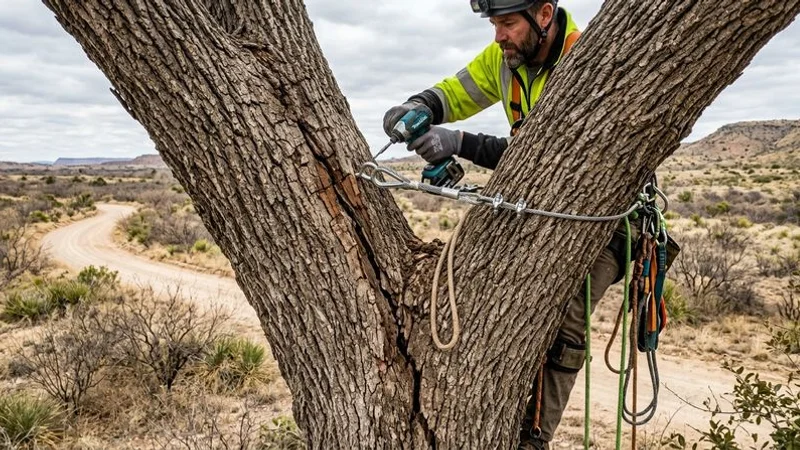
Traditional static systems use Extra High Strength (EHS) steel cables with fixed-length hardware installed between attachment points. Our crews tension this heavy-duty cable to limit branch movement to a very strict, defined range.
A standard 5/16-inch EHS cable boasts a breaking strength of over 11,200 pounds, making it incredibly reliable for massive limbs. Static systems are strong and durable, typically lasting 10 to 15 years before the hardware requires replacement.
These steel cables are necessary when a branch must be prevented from moving toward a specific target like a roof or a power line.
Dynamic Cabling Systems
Dynamic cabling uses synthetic, UV-resistant ropes that allow branches to sway naturally within a limited range. We frequently install friction-based brands like Cobra or BOA because they require absolutely no drilling into the wood.
These flexible systems usually feature load capacities ranging from 2 tons to 8 tons depending on the rope thickness. Dynamic systems encourage the tree to continue developing reaction wood, which is the tree’s natural way of building strength against the wind.
Because they allow for adaptation, dynamic ropes are highly preferred for younger trees where some movement is beneficial.
System Comparison
Choosing the correct hardware is critical for long-term tree health. Our recommendations align with the specific structural needs of your landscape.
Here is a quick breakdown of how these materials differ:
| Feature | Static (Steel EHS) | Dynamic (Synthetic Rope) |
|---|---|---|
| Installation Method | Drilled hardware (Eye bolts/Lags) | Friction-based (No drilling) |
| Movement Allowed | Minimal to none | Natural sway with limits |
| Average Lifespan | 10 to 15 years | 5 to 8 years |
| Best Used For | Severe splits, targets below | Younger trees, minor support needs |
Which System for San Angelo
The local climate plays a major role in how these materials age and perform. We recommend dynamic setups for moderate structural issues to help native trees adapt to the constant West Texas winds.
Static systems remain the standard for older, massive live oaks with severe defects hanging directly over homes. Many large-scale installations successfully utilize a combination of both rigid steel and flexible synthetic ropes.
The Installation Process
Professional tree cabling and bracing installation requires strict adherence to industry safety standards. We follow the current ANSI A300 Part 3 standard, which dictates the exact rules for supplemental support systems in trees.
Here is what the physical installation process looks like in the field.
Assessment
Before any hardware goes up, a certified arborist evaluates root stability, overall vigor, and the specific defect. Our assessment calculates the weight distribution of the canopy and accounts for the direction of prevailing winds.
In San Angelo, prevailing spring winds arrive heavily from the south and southwest. This localized weather pattern dictates exactly where cables are placed to absorb the heaviest wind loads.
Cable Installation
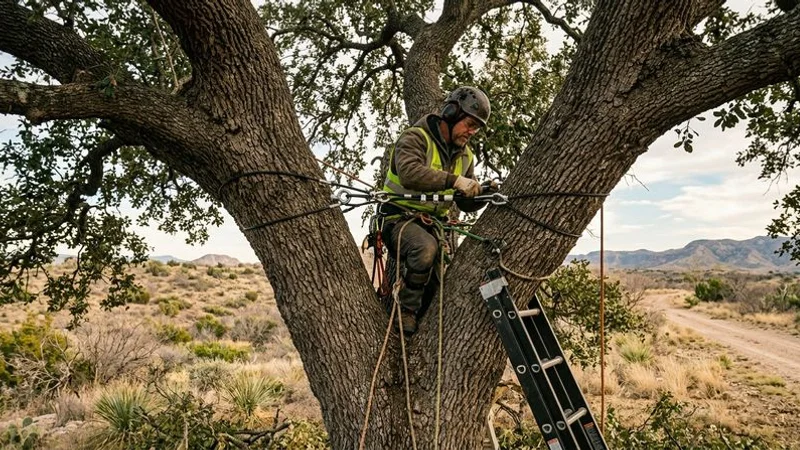
For static systems, the installer climbs to the attachment points and drills through the branches to insert heavy-duty J-lag bolts or drop-forged eye bolts. We thread the steel cable through specialized thimbles to prevent fraying and tension it using a commercial grip hoist.
Industry guidelines require positioning the cable approximately two-thirds of the distance from the weak crotch to the ends of the branches. For dynamic setups, the installer simply wraps the synthetic rope around the limbs at the specified height using expanding inserts.
Bracing Rod Installation
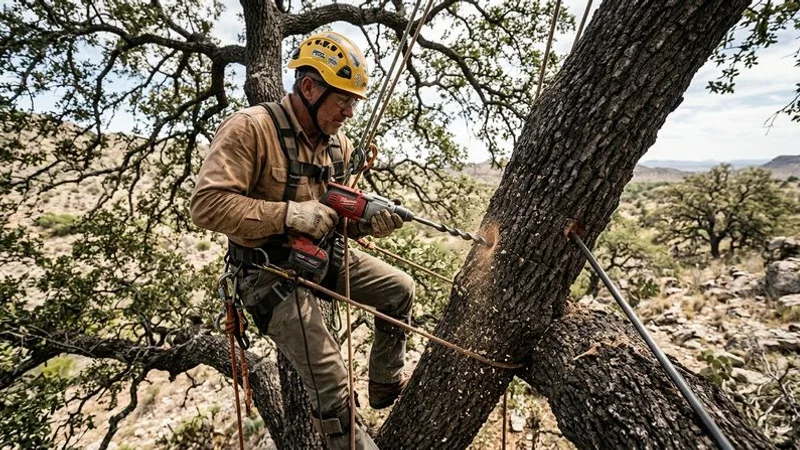
Bracing tackles the problem lower down by drilling completely through the failing branch junction. Our technicians push a threaded steel rod through the wood and secure it with heavy washers and nuts on both sides.
The rod acts like a rigid pin to hold the two halves of the split firmly together. Multiple steel rods are standard for massive trunk splits, often installed in tandem with a cable higher up for maximum leverage.
Post-Installation
After completing the tensioning, the arborist documents the exact hardware specifications for future reference. We provide you with a written report detailing the inspection schedule and ongoing care requirements.
This paper trail is crucial for tracking the aging of the materials.
Maintenance Requirements
Supplemental support systems are highly effective, but they are not permanent, maintenance-free solutions. We require property owners to treat these installations as active structures that need routine monitoring.
Regular hardware check-ups prevent catastrophic failures down the road.
- Annual visual inspection. A certified professional should evaluate the system from the ground at least once a year. The inspection checks cable tension, looking closely at how the tree is growing around the anchor points.
- Post-storm inspection. High winds and heavy ice loading can severely stretch cables or shift friction bands. We perform targeted assessments immediately following major weather events in the Concho Valley to catch loosened bolts early.
- Hardware replacement. Steel components generally require complete replacement every 10 to 15 years as the metal fatigues and tree growth alters the geometry. Dynamic ropes degrade from UV exposure and require replacement every 5 to 8 years.
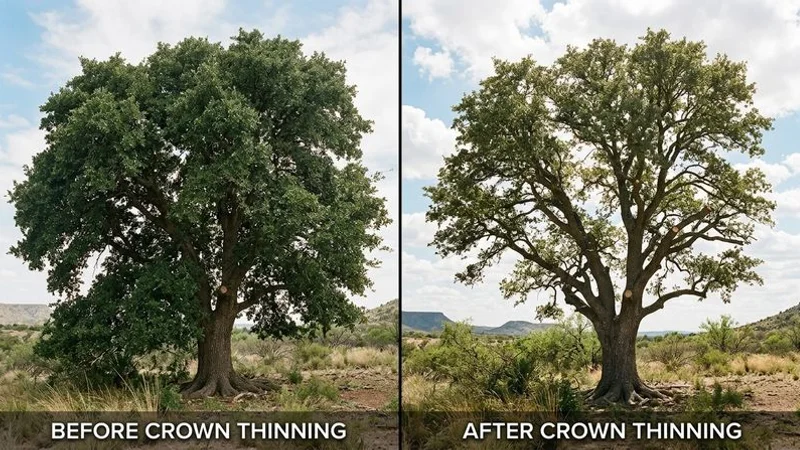
- Pruning adjustments. Routine canopy weight reduction prevents the supported limbs from outgrowing the capacity of the cable. Tree trimming to remove deadwood and thin the crown reduces the sail effect catching the wind.
When Removal Is the Better Choice
Despite advanced technology, mechanical support cannot save every compromised tree. We always look for the safest route, and sometimes removal is the only responsible option to protect your property.
Industry guidelines suggest removal over reinforcement when internal decay compromises more than 30% of the trunk cross-section. Other major disqualifiers include severed structural roots, severe crown dieback indicating poor health, or the presence of multiple compounding defects.
A certified arborist brings objective data to help you weigh the financial costs of long-term maintenance against the risk of total failure. In many cases, the final decision comes down to your personal risk tolerance and the tree’s proximity to gathering areas.
At San Angelo Texas Tree Service Pros, providing safe, effective solutions for aging landscapes is a major priority. We evaluate properties throughout Tom Green County to identify hazardous limbs before they drop.
Certified arborists on the team install top-tier static and dynamic rigging to give your valuable shade trees a second chance. Our crew is ready to help if you suspect a cracked trunk requires immediate attention.
Reach out today for a professional assessment to see if Tree Cabling and Bracing: Saving Trees with Structural Support is the right fit for your property.
Tags: