5 Signs a Tree on Your Property Needs to Be Removed
Learn the five critical warning signs that indicate a tree on your San Angelo property may need professional removal. Protect your home and family by recognizing these dangerous tree conditions early.
We often see property owners struggle to decide when a beloved shade provider has become a genuine safety risk. Balancing the natural beauty of a landscape against the realities of property safety requires a critical eye.
Our team at San Angelo Texas Tree Service Pros evaluates hundreds of residential properties across Tom Green County each year to answer this exact question. Spotting the early warning signs of structural failure can save you thousands of dollars in emergency damage repairs and unnecessary tree removal costs.
We are going to break down the specific indicators of critical decline and outline exactly how to evaluate your property.
Let us look at the data, what it actually tells us, and then explore the 5 signs a tree on your property needs to be removed.
1. More Than 25 Percent of the Crown Is Dead
We expect to see a few leafless twigs throughout the year, as minor dieback is a completely normal part of the growth cycle. A healthy canopy constantly sheds older, shaded growth to direct energy toward new foliage.
Our concern arises when more than a quarter of the branches become barren, signaling severe vascular compromise. Arboricultural standards dictate that a tree losing more than 25 percent of its foliage is often considered a total loss.
The Threat of Hypoxylon Canker
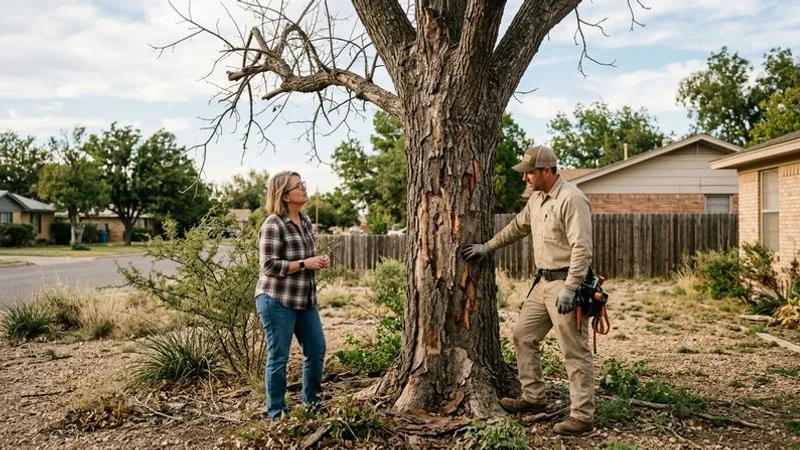
We frequently encounter cases where this extensive dieback stems from opportunistic tree diseases like Hypoxylon canker. This devastating fungus thrives in the hot Texas climate, attacking stressed oaks and mesquites to form distinct silver or black fungal mats under peeling bark.
Our arborists note that once these visible fungal mats appear, the internal damage is typically irreversible. Dead wood rapidly turns brittle and creates a severe safety hazard during high winds.
We always recommend prompt action because a large limb falling from 40 feet can effortlessly crush roofing or vehicles. Property owners should monitor the canopy for several specific indicators.
- Bare branches: Leafless limbs persisting through the active spring growing season.
- Brittle wood: Limbs that snap crisply instead of bending under pressure.
- Bark loss: Sections of exterior bark falling away to reveal dry, discolored wood.
- Fungal mats: Visible silver or black patches on the main trunk.
Our clients often find that proactive trimming, which averages $255 to $655 locally, is far more affordable than a full hazard extraction. Targeted pruning can sometimes save a specimen if less than 15 percent of the canopy is affected.
We consider complete removal the only safe, logical choice once widespread decay sets in. The visual evidence of this decline is often stark and undeniable.
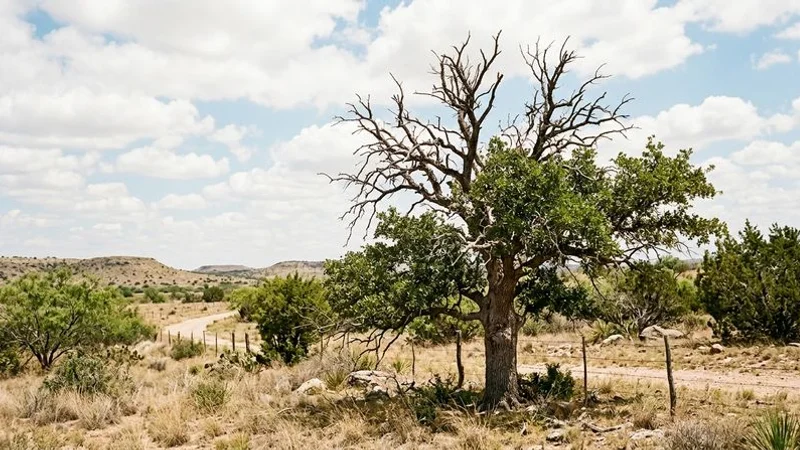
2. Trunk Decay and Cavities
The main trunk serves as the primary structural backbone supporting the entire weight of the upper canopy. We see catastrophic failures occur when internal decay compromises this critical support column.
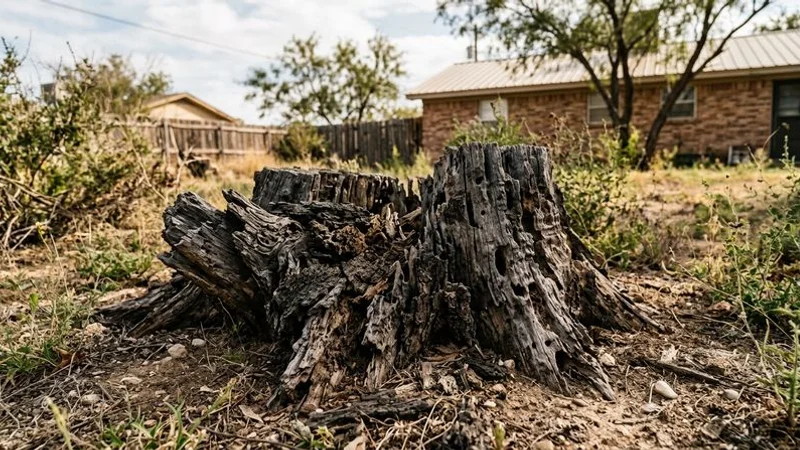
Fungal infections and wood-boring insects can silently hollow out native mesquites and live oaks from the inside out. Our inspections often reveal that significant internal rot is practically invisible to the untrained eye until it reaches a dangerous stage.
Professional Diagnostic Tools
Modern arboriculture relies on specialized technology to measure hidden structural integrity accurately. Our team utilizes Resistograph testing to detect internal defects without causing unnecessary harm to the bark or sapwood.
This sophisticated device uses a 3-millimeter micro-drill bit to measure wood density with over 90 percent accuracy. We rely on this data to determine exactly how much solid wood remains around a hollow cavity.
Certain visual clues on the exterior of the trunk require immediate professional evaluation. We strongly advise homeowners to watch for the following warning signs.
| Exterior Warning Sign | Hidden Structural Meaning |
|---|---|
| Mushroom Growth | Fleshy fungi at the base indicate active root or heartwood rot. |
| Deep Cavities | Hollow sections reduce the load-bearing capacity of the main stem. |
| Vertical Cracks | Splits running up the trunk suggest critical internal tension failures. |
| Spongy Wood | Soft texture confirms the presence of advanced moisture-driven decay. |
Fruiting bodies like shelf fungi are not just harmless lawn growths. We recognize them as the visible reproductive stage of an infection that has already consumed the internal lignin.
A heavily decayed trunk can snap unexpectedly during a standard West Texas thunderstorm. Our objective is to identify and safely extract these compromised specimens before they fall on a nearby structure.
3. Root Damage and Heaving
A healthy root system anchors the massive above-ground structure while absorbing essential water and nutrients. We consider any major disruption to this hidden network a serious threat to long-term stability.
The Critical Root Zone extends outward far beyond the visible drip line of the canopy. Our most frequent calls for unstable trees involve recent construction, utility trenching, or landscaping changes that severed these essential anchor lines.
The Impact of Soil Compaction
Heavy equipment or vehicles parked under the canopy crush the microscopic air pockets required for respiration. We frequently encounter severe root dieback in San Angelo due to this intense soil compaction in our native clay.
An injured root plate simply cannot support the massive wind loads generated during spring storms. Our rule of thumb states that if more than 50 percent of the root zone sustains damage, recovery is highly improbable.
Ground-level indicators often provide the earliest warning of subterranean failure. We instruct property owners to inspect the soil surface for these specific red flags.
- Soil Heaving: Lifted or cracked dirt on one side indicates the root plate is actively pulling out of the ground.
- Exposed Decay: Dead brittle roots visible above the soil line point to long-term moisture or disease issues.
- Fungal Activity: Mushrooms growing in a ring around the base often signal advanced root rot.
- Sudden Leaning: A noticeable shift in posture suggests the primary anchor roots have snapped.
The effects of below-ground injury typically remain invisible until the canopy begins to lean or thin. Our safety protocol requires immediate removal for any specimen exhibiting active soil heaving.
4. Severe or Progressive Lean
Many native specimens naturally grow at a slight angle to chase sunlight or adapt to prevailing winds. We do not immediately condemn a trunk just because it lacks perfect vertical alignment.
A gradual historical curve is usually compensated for by thicker tension wood on the opposite side. Our primary concern focuses entirely on sudden shifts or new progressive movement.
Measuring Critical Angles
A newly developed lean indicates that the structural roots on the tension side have broken beneath the surface. We use precise instruments like clinometers to measure these changes rather than relying on visual guesses.
Industry safety guidelines classify any new lean exceeding 15 degrees from vertical as an imminent hazard. Our team automatically prioritizes these evaluations, especially if the potential fall zone includes a house, driveway, or power line.
Evaluating a suspect angle requires answering several basic questions about the surrounding environment. We ask clients to observe the following details before our arrival.
| Assessment Question | What It Reveals About Stability |
|---|---|
| Is the soil cracking? | Ground heaving opposite the lean proves active uprooting. |
| Are roots exposed? | Lifted roots indicate a complete failure of the anchoring system. |
| Is the angle changing? | Progressive movement means the tree is in the process of falling. |
| What is the target? | Structures or walkways in the path dictate the emergency level. |
Even if the movement appears to stop, the microscopic root tearing that caused the initial shift will continue to worsen. We strongly advise against waiting to see if a recently tilted specimen will stabilize on its own.
5. Storm Damage Beyond Repair
Severe thunderstorms, straight-line winds, and occasional ice accumulations regularly test the limits of local landscaping. We respond to countless emergency calls after these weather events inflict devastating structural breaks.
While minor branch loss is purely cosmetic, massive limb failures create wounds too large for the bark to seal. Our assessments focus on the biological process called CODIT, or Compartmentalization of Decay in Trees.
Assessing Post-Storm Survival
A specimen relies on this sealing process to block internal fungal infections after a physical injury. We know that a split trunk where the main leaders have completely separated cannot be successfully compartmentalized.
Losing more than 50 percent of the canopy suddenly deprives the organism of its ability to photosynthesize required energy. Our crews frequently see these heavily damaged survivors slowly starve to death over the following two growing seasons.
Attempting to save a thoroughly wrecked trunk usually results in an ongoing financial drain for the property owner. We want to help you avoid paying for expensive restorative pruning on a specimen that will require complete extraction within a year.
- Canopy Loss: Loss of more than half the leafy canopy from straight-line winds.
- Trunk Splitting: Major vertical splitting down the main trunk.
- Bark Damage: Large strips of bark blasted away by hail or flying debris.
- Uprooting: Partial uprooting accompanied by a newly developed lean.
Emergency tree service extractions after a storm typically carry a premium, adding anywhere from $200 to $800 over standard seasonal rates. We always recommend taking care of weakened branches before the storm season arrives to avoid these premium costs.
When in Doubt, Get a Professional Assessment
Deciding when a beloved property feature has reached the end of its safe lifespan is rarely easy. We know that taking swift action on these 5 signs a tree on your property needs to be removed prevents disastrous property damage.
Professional diagnostics reveal the hidden internal decay and root failures that surface-level observations miss. Our certified arborists at San Angelo Texas Tree Service Pros provide honest, data-driven health assessments throughout Tom Green County.
Sometimes a seemingly declining specimen can be completely rejuvenated with a cost-effective treatment plan. We provide transparent, upfront quotes detailing exactly why an extraction is necessary if the damage proves irreversible.
Protecting your real estate investment means knowing when to treat an issue and when to eliminate a hazard. We invite you to schedule a free health assessment today to secure the safety and natural beauty of your landscape.
Tags: