Filing Insurance Claims for Storm-Damaged Trees in Texas
A comprehensive guide for Texas homeowners on filing insurance claims for storm-damaged trees. Learn what your policy covers, how to document damage, work with adjusters, and navigate the claims process in San Angelo and West Texas.
We see the aftermath of severe weather across West Texas every single spring.
Those straight-line winds and sudden ice storms turn beautiful landscape features into massive liabilities.
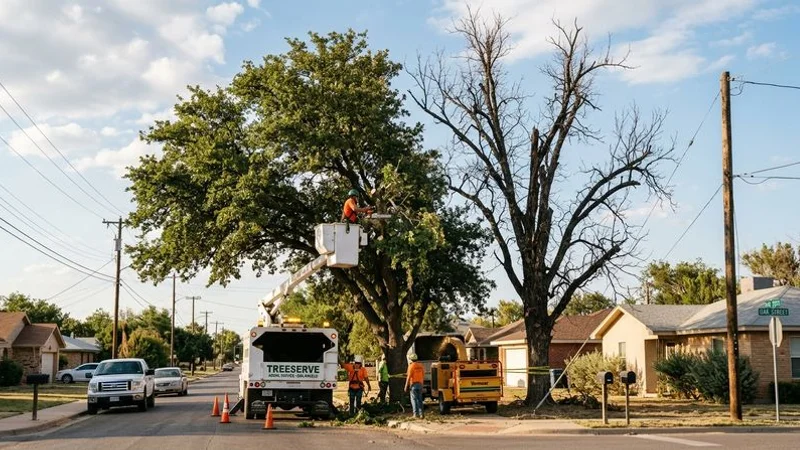
Our team at San Angelo Texas Tree Service Pros is dedicated to providing high-quality tree care and arboriculture solutions for both residential and commercial properties.
Filing Insurance Claims for Storm-Damaged Trees in Texas often feels like a frustrating battle for many property owners.
We know that standard fixed deductibles are rare right now.
A 2 percent wind and hail deductible is the new reality for property claims.
Let’s look at the 2026 data on exactly what HO-3 policies cover, how adjusters evaluate damage, and the specific steps to secure a fair payout.
What Texas Homeowners Insurance Covers
Our standard homeowners insurance policies in Texas, specifically HO-3 policies, provide very strict limits for storm damage.
Understanding these exact thresholds helps you set realistic financial expectations before making a call.
We recommend reviewing your declarations page immediately to find your specific coverage caps.
Here is a quick breakdown of how claims differ based on where the falling debris lands.
| Damage Scenario | Typical Coverage Type | Estimated Financial Limit |
|---|---|---|
| Tree hits house or garage | Dwelling / Other Structures | Up to total policy limit |
| Tree blocks driveway | Debris Removal | Usually $500 to $1,000 |
| Tree falls in empty yard | Yard Debris (Often limited) | $0 to $500 maximum |
Damage to Structures
A falling tree that damages a covered structure like your house, a detached garage, or a fence triggers your primary dwelling coverage.
This remains the most straightforward and valuable part of a tree-related claim.
We often see large live oaks punch through roofs during intense thunderstorms in the Concho Valley.
According to a 2026 ValuePenguin analysis, average Texas roof replacement costs now exceed $11,500.
Our crews coordinate directly with roofing contractors to prevent further water intrusion.
These structural impact claims cover both the home repairs and the extraction of the massive trunk itself.
Tree Removal from Structures
Emergency tree service extraction from a residential structure is an expensive and highly technical operation.
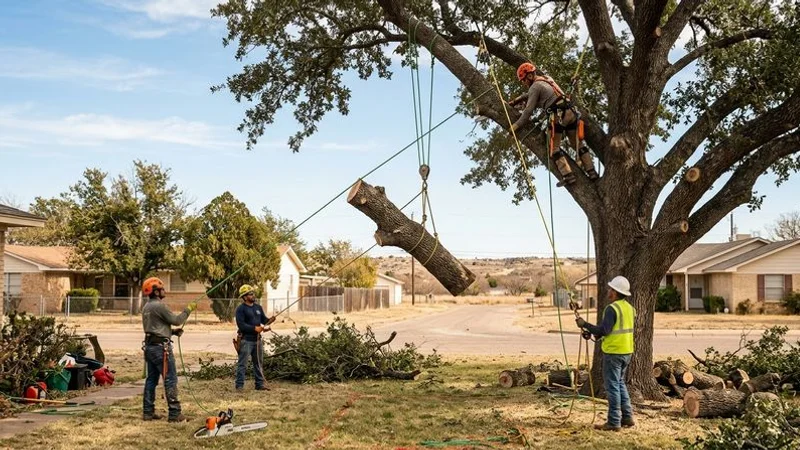
Our specialists use heavy cranes and complex rigging systems to safely lift thousands of pounds of wood off fragile roof trusses.
Angi’s 2026 cost data shows that basic professional tree removal averages $750 in Texas.
Emergency jobs cost significantly more.
We routinely see invoices exceed $10,000 when extracting a massive trunk resting on a living room or tangled in power lines.
Your policy generally covers these high extraction costs because removing the hazard is absolutely required to fix the covered dwelling.
Tree Removal from Yards
Coverage drops significantly if a tree falls in your yard without striking a building.
Most standard HO-3 policies limit yard tree removal to just 5 percent of your total dwelling coverage.
We find that carriers like State Farm and Allstate often impose a strict cap of $500 per tree.
A maximum limit of $1,000 per occurrence for yard removal is standard across the Texas market.
If a summer microburst knocks down three massive pecan trees on your lawn, you might only recover $1,000 total.
This minimal payout rarely covers the true cost of bringing in a professional crew, heavy stump grinders, and large hauling trucks.
- Stump grinding services: $150 to $350 per stump.
- Wood chipping: $100 to $200 per hour.
- Hauling fees: $300 per heavy truckload.
Debris Removal
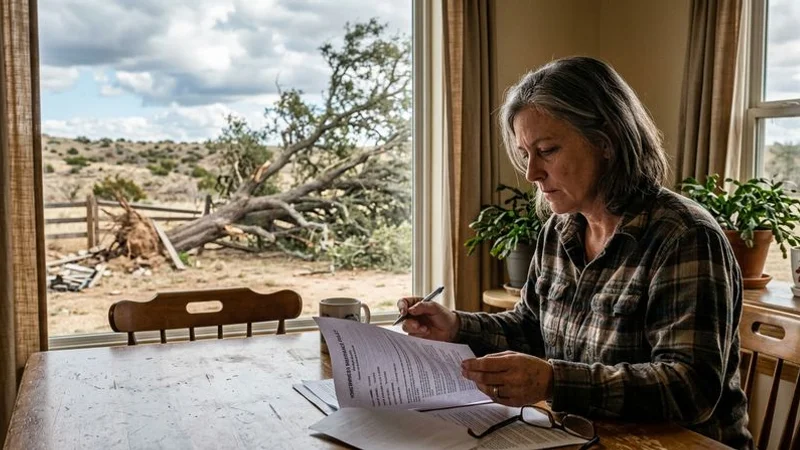
Hauling away the scattered branches and shattered wood is classified as debris removal.
The Texas Department of Insurance treats this as a separate limit from structural repair costs.
We usually see standard policies cap general debris removal at around $500.
Local landfill tipping fees in West Texas average $45 per ton in 2026, making bulk disposal quite expensive.
What Is Not Covered
Insurance companies investigate the exact cause of a tree failure before cutting any checks.
We see adjusters aggressively look for reasons to classify the damage as a maintenance issue.
The following situations routinely result in swift claim denials.
- Neglect and poor maintenance: Adjusters will deny the claim if an ISA Certified Arborist determines the tree was dead, diseased, or heavily decayed before the storm.
- Flood damage: Standard homeowners policies exclude ground floods. Following the historic July 2025 floods in San Angelo, affected property owners had to rely on separate FEMA National Flood Insurance Program policies.
- Gradual leaning: Trees that slowly tip over without a specific storm event are classified as homeowner negligence.
- Neighbor disputes: If a neighbor’s healthy tree falls onto your property, your own insurance handles the cleanup. You cannot target their policy unless you have prior written documentation proving they ignored an official warning about a hazard.
How to Document Your Claim
Thorough documentation forces the insurance company to process your file accurately and quickly.
Our specialists recommend gathering physical evidence the minute it is safe to walk outside.
A well-documented file leaves very little room for an adjuster to lowball your settlement.
Photograph and Video Everything
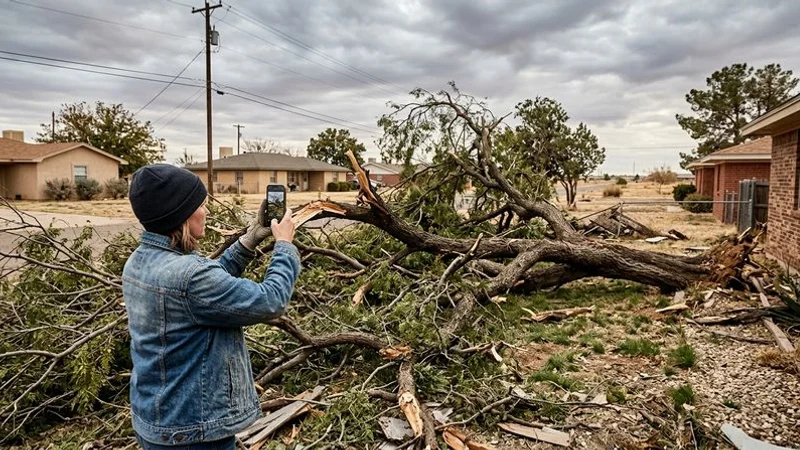
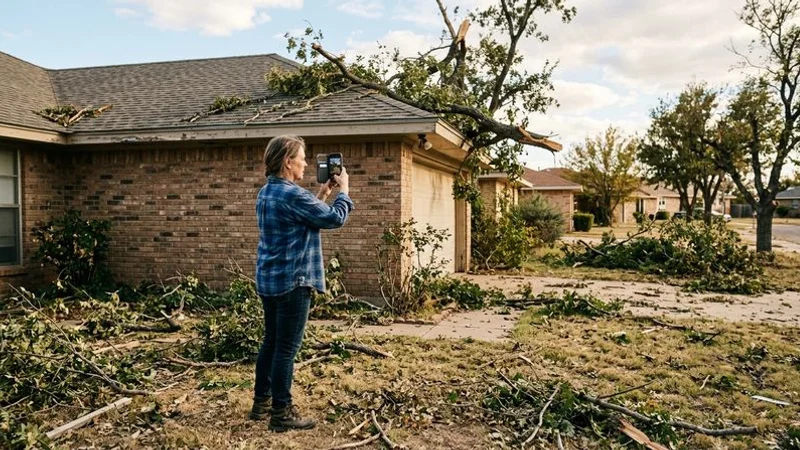
Snap comprehensive photos from every possible angle before anyone touches the debris.
Capture the full scene showing the exact impact point, the exposed root plate, and the shattered trunk.
We advise clients to record a continuous video walking around the damage while narrating the specific destruction.
Clear footage of green, healthy leaves attached to the fallen branches proves the canopy was alive before the storm hit.
Adjusters rely heavily on timestamped metadata from smartphone cameras to verify the precise date of loss.
Document Pre-Storm Condition
Insurance adjusters love clear before-and-after comparisons.
Pull up Google Street View images, recent real estate listing photos, or family snapshots taken in the yard.
Our team uses the historical imagery feature in Google Earth Pro to show the canopy’s previous health.
These dated images serve as undisputed proof of structural integrity prior to the high winds.
Get Professional Assessments
A formal inspection by an ISA Certified Arborist carries massive weight with corporate claims departments.
These professionals verify the exact species, approximate age, and structural stability of the wood.
We provide written arborist assessments formatted specifically for major insurance carriers.
The official report outlines the cause of failure analysis using the ISA Tree Risk Assessment Qualification (TRAQ) standards.
This documentation proves the loss was a direct result of a covered weather peril.
Keep Detailed Records
Start a dedicated physical file folder for every piece of paper tied to the event.
This specific file must hold your arborist reports, initial printed photos, and all written correspondence.
We remind homeowners that the Texas Prompt Payment of Claims Act (Chapter 542) requires insurers to acknowledge your claim within 15 days.
Keeping a strict timeline holds them accountable to state law.
- Written estimates: Collect exact quotes from local tree removal companies and structural contractors.
- Emergency invoices: Keep all receipts for emergency board-up services or temporary roof tarps.
- Communication logs: Record the dates, times, and full names of every insurance representative you speak with.
Working with Insurance Adjusters
The insurance company sends a field adjuster to calculate your final payout.
Their primary job is to protect the corporate bottom line, so you must advocate aggressively for your property.
Our experts suggest walking the property alongside the adjuster during their initial inspection. Point out hidden secondary damage like cracked drywall, shifted door frames, and subtle water stains on the ceiling.
”Never accept the first estimate blindly. Adjusters write quotes based on standardized software pricing, which frequently lags behind the actual, real-world cost of specialized crane rentals and emergency labor in Texas.”
We highly recommend getting two independent estimates from licensed local contractors.
Many desk adjusters use Xactimate software to offer a standard $2,000 for extraction. If local West Texas crews quote $5,500 due to complex rigging needs, those independent estimates give you incredible leverage.
This written proof allows you to demand a fair financial supplement.
Understanding Your Deductible
The financial math of filing a claim changed drastically in recent years across Tom Green County and the rest of the state.
Our clients often assume they have a flat $1,000 deductible, only to discover a much higher threshold.
Data from the Texas Office of Public Insurance Counsel (OPIC) in 2026 highlights a massive shift toward percentage-based wind and hail deductibles.
| Policy Detail | Example Amount |
|---|---|
| Insured Home Value | $300,000 |
| Deductible Rate | 2 Percent Wind and Hail |
| Out-of-Pocket Cost | $6,000 Initial Expense |
You must absorb this $6,000 cost before the insurance company pays a single dollar.
We advise reviewing your declarations page immediately to confirm your exact financial exposure.
Filing a claim for $4,000 worth of damage makes zero financial sense if your deductible sits at $6,000. A low-value claim will only spike your future premium rates without providing any immediate payout.
Best Practices for Filing Insurance Claims for Storm-Damaged Trees in Texas
Speed and precision determine exactly how fast you get a settlement check.
Texas law requires you to file claims within a reasonable window, so do not delay the initial phone call.
Our crews always recommend taking immediate steps to prevent further rain from entering the house. Cover exposed roof decking with heavy-duty tarps and save the hardware store receipts for total reimbursement.
- Avoid Assignment of Benefits (AOB): Do not sign an AOB document with a pushy contractor. Texas House Bill 2102 makes it illegal for contractors to waive deductibles, and an AOB completely strips your control over the financial settlement.
- Consider a public adjuster: Hire a licensed public adjuster if the structural damage is catastrophic. They take a small percentage of the final payout, but their expertise forces the carrier to honor the true replacement cost.
- Call the TDI Helpline: If your carrier delays payment beyond state deadlines, the Texas Department of Insurance consumer helpline provides powerful leverage.
- Submit promptly: Promptly submitting a detailed, well-documented file guarantees the best possible outcome for your property.
We know that cleaning up after a major West Texas storm is completely exhausting work. A clear understanding of your HO-3 policy limits turns a stressful guessing game into a predictable business transaction. Secure independent estimates, document the health of your landscaping, and hold your provider to the terms of the contract.
Our certified local arborists are ready to assess any hazardous canopy leaning over your roof today. Start your paper trail early and protect your primary investment.
Filing Insurance Claims for Storm-Damaged Trees in Texas goes smoothly when you have the right evidence firmly in hand.
Tags: