Crown Thinning vs Crown Raising: Which Pruning Method Is Right?
Understand the difference between crown thinning and crown raising pruning methods. Learn when each technique is appropriate for your San Angelo trees and how they affect long-term tree health.
You know how frustrating it is when technical jargon gets in the way of proper property maintenance. We hear the confusion between “crown thinning” and “crown raising” constantly, and this simple misunderstanding often results in irreversible canopy damage.
For example, removing just 10 percent too much foliage in a single season can permanently stunt a mature oak. That specific data point is the dividing line between a healthy canopy and a tree struggling to survive the Texas summer.
The conversation surrounding Crown Thinning vs Crown Raising: Which Pruning Method Is Right? happens with homeowners on a daily basis. Let’s look at the actual arboriculture data, break down the national benchmarks, and outline exactly how to choose the correct approach for your landscape.
What Is Crown Thinning?
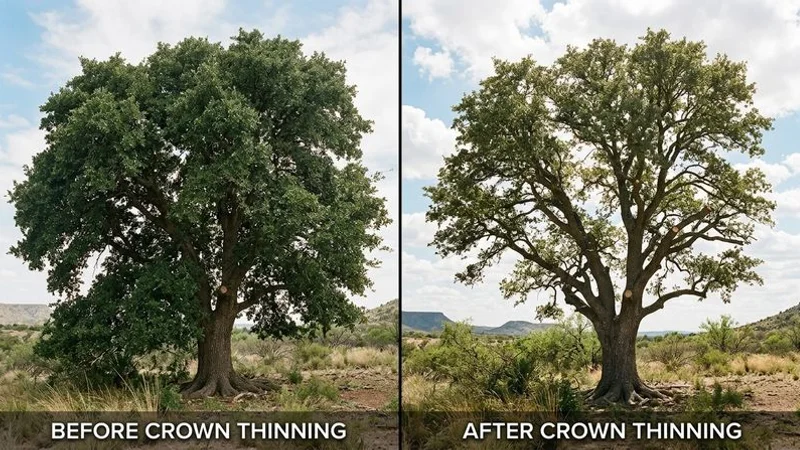
Crown thinning involves the selective removal of live branches throughout the canopy to reduce overall density. The primary goal is to open up the internal structure so sunlight and air can pass through freely. Our team focuses on maintaining the natural shape of the tree while eliminating problematic growth patterns.
During a standard crown thinning session, an arborist removes:
- Small interior branches that crowd the main structure
- Crossing or rubbing limbs that create open bark wounds
- Dead, diseased, or dying branches
- Weak growth with poor attachment points
- Water sprouts and root suckers draining the tree’s energy
The fundamental principle of thinning relies on even distribution. A properly thinned tree simply looks like a cleaner, more open version of its natural self. Our standard practice strictly follows the American National Standards Institute (ANSI) A300 pruning guideline. This foundational rule states that no more than 25 percent of a tree’s live foliage should be removed in a single annual growing season.
Removing more than 25 percent shocks the root system and triggers aggressive, weak water sprout growth. The tree will actually weaken over time and become highly susceptible to disease. We always use sharp bypass pruners, like Felco hand tools, and professional STIHL pole saws to make clean cuts at the branch collar.
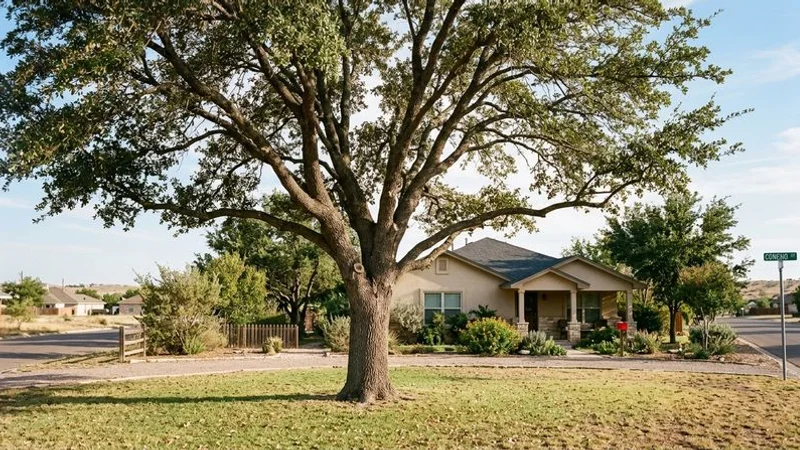
Benefits of Crown Thinning
Wind resistance remains the most critical benefit for properties in West Texas. Wind speeds in San Angelo frequently hit 60 to 70 mph during summer severe thunderstorms. Our crews always recommend crown thinning before storm season to let that extreme wind pass harmlessly right through the branches.
A dense, heavy canopy acts like a giant sail catching those extreme winds. Once the tree is selectively thinned, the risk of uprooting drops significantly.
Better light penetration serves as another massive advantage. Thinning allows sunlight to filter down to the lower branches and the turfgrass beneath the tree.
We also use thinning to improve air circulation within the tree. Better airflow directly prevents fungal leaf diseases, such as powdery mildew, during the humid late summer periods in the Concho Valley. Removing excess growth physically lightens the load on long limbs, preventing branches from snapping under their own weight.
What Is Crown Raising?
Crown raising focuses entirely on the bottom portion of the tree. This method requires removing the lowest branches to increase the vertical clearance beneath the canopy. Our technicians use crown raising, also called crown lifting, primarily for functional clearance rather than structural health.
Common reasons for scheduling a crown raising service include:
- Clearing sidewalks for pedestrians (usually an 8-foot minimum)
- Making room for vehicles on driveways and streets
- Allowing morning sunlight to reach struggling turfgrass
- Opening up sight lines around intersections for security
- Creating functional space for outdoor patios or play areas
Cities across Texas enforce strict municipal clearance rules for trees overhanging public spaces. For example, Section 48-11 of the Dallas city code mandates a 15-foot clearance over roadways. We typically cut back to at least an 8-foot clearance for residential sidewalks to keep property owners perfectly compliant with local urban forestry ordinances.
How Crown Raising Is Performed
An arborist starts at the bottom and selectively removes limbs back to the main trunk. The cuts must be made just outside the branch collar to ensure the wound heals properly. Our experts follow strict structural guidelines, utilizing the three-cut method to prevent heavy branches from peeling the bark down the trunk. This technique involves an undercut, a top cut to drop the weight, and a final clean cut at the swollen branch attachment point.
According to the ANSI A300 standard, the live crown should make up at least two-thirds of the total tree height after a crown raising service is completed.
If you raise the canopy too high, the tree becomes dangerously top-heavy. A 30-foot tree needs a live canopy of at least 20 feet, meaning the lowest branches should be no higher than 10 feet off the ground.
Benefits of Crown Raising
Functional clearance acts as the absolute biggest benefit of this specific technique. You can finally walk, mow, or park under your mature pecan or live oak without dodging low limbs. We frequently perform crown raising to improve property security by opening up sight lines around ground-floor windows and doors.
Raising the canopy also prevents major moisture issues around your foundation. Branches resting on the ground or against your roof trap moisture and invite pests right into your home. This simple pruning strategy keeps termites and carpenter ants away from your exterior walls.
Crown Thinning vs Crown Raising: Which Pruning Method Is Right? A Side-by-Side Comparison
Deciding between these two services depends entirely on the specific problem you need to solve. We built this quick comparison to help you understand the core differences at a glance.
| Feature | Crown Thinning | Crown Raising |
|---|---|---|
| Primary Goal | Reduce canopy density and weight | Increase vertical clearance below |
| Area of Focus | Throughout the entire canopy | Only the lowest branches |
| Storm Benefit | Allows high winds to pass through | Keeps branches off roofs and fences |
| Aesthetic Result | Open, airy, natural shape | Taller, umbrella-like appearance |
| Key Limitation | Max 25% removal per year | Leave 2/3 of tree height as canopy |
If you have a dense, heavy tree catching the wind, crown thinning is the correct choice. If low branches are blocking your driveway or hitting your fence, crown raising provides the exact solution you need. Our crews often combine both methods during a single service visit for large, mature trees.
A large live oak might need its lower branches raised for street clearance and its upper canopy thinned to survive severe weather. Combining these services proves highly cost-effective for homeowners in the Concho Valley.
Recent 2026 industry data shows professional tree trimming in Texas averages around $460 per tree, with most jobs ranging between $400 and $900 depending on size and access. We can build a comprehensive pruning plan that handles both clearance and density issues in one appointment, saving you significant money compared to booking separate visits.
ANSI A300 Standards: Why They Matter
The ANSI A300 standards serve as the absolute foundation of professional tree care in the United States. These national guidelines dictate exactly how cuts should be made and how much live tissue can be safely removed. Our arborists rely on these updated 2024 consolidated standards to protect your property and ensure the long-term survival of your landscape.
Key ANSI A300 guidelines prohibit several damaging practices:
- Removing more than 25 percent of live foliage in one year is strictly prohibited.
- Making flush cuts that damage the trunk tissue is never allowed.
- Using heading cuts that chop a branch to an arbitrary length should be avoided.
- Lion-tailing, which strips interior branches and leaves only tip foliage, severely weakens the tree.
- Topping, the practice of cutting main leaders down to stubs, is always unacceptable.
Any tree service you hire in the Concho Valley must follow these rules. The US Civil Court system actually uses these exact ANSI standards as the final authority in property damage disputes involving trees. We highly recommend asking any prospective arborist directly about their compliance with ANSI A300 before letting them start up a chainsaw on your property.
The Impact on Long-Term Tree Health
Proper pruning directs your tree’s energy into strong, stable growth. Removing weak or problematic limbs early prevents them from tearing off and creating massive wounds during a storm. We consistently observe how correct thinning and raising extend the lifespan of urban trees.
Improper pruning causes rapid decline and creates major safety hazards. Over-thinned trees or topped canopies push out desperate, weakly attached water sprouts that break off easily in high winds. Bad cuts also attract nitidulid beetles, the primary insect responsible for spreading deadly oak wilt across West Texas.
To protect your mature trees, always prioritize these long-term health factors:
- Hire arborists who strictly sanitize their chainsaws and handsaws between trees.
- Schedule major oak pruning during the colder winter months to avoid sap-feeding insects.
- Never let a contractor remove more than 25 percent of the live foliage.
Mature trees in San Angelo represent incredibly valuable assets for your property value. A large pecan tree takes half a century to reach its full size and shade potential. Our team is dedicated to protecting that investment by using scientifically backed arboriculture methods that prioritize both safety and biology.
Conclusion
Answering the question of Crown Thinning vs Crown Raising: Which Pruning Method Is Right? comes down to your specific landscape goals and safety requirements.
If you are unsure which method your property needs, reach out for a professional assessment. We offer free consultations to evaluate your landscape and build a custom pruning plan.
Contact San Angelo Texas Tree Service Pros today to get your trees ready for the upcoming season.
Tags: