Can Old Tree Stumps Attract Termites and Pests?
Learn how old tree stumps on your San Angelo property can attract termites, carpenter ants, beetles, and other pests. Understand the risks to nearby structures and why stump removal is essential pest prevention.
You know how easy it is to simply mow around a leftover tree stump and forget about it.
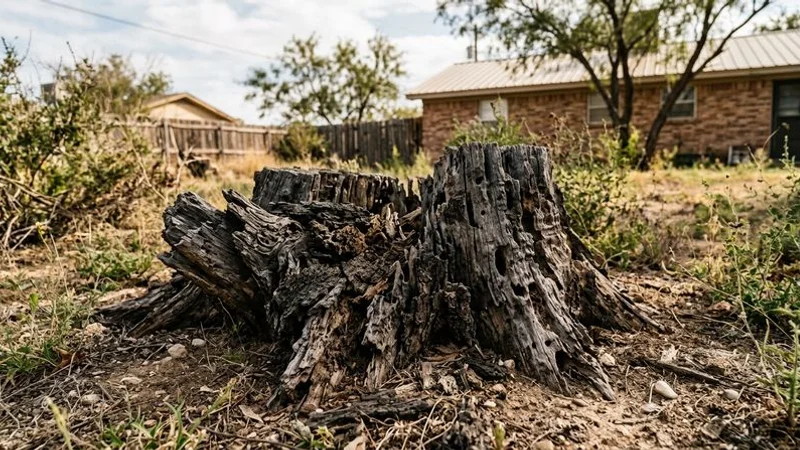
We hear the same critical question from homeowners across San Angelo almost every week: Can old tree stumps attract termites and pests? The reality is that these decaying yard features function as massive incubators for some of the most destructive insects in the US.
As experts at San Angelo Texas Tree Service Pros, our team constantly finds that leaving a stump untouched gives wood-destroying colonies a protected stronghold right near your foundation. This decomposition process creates a moisture-rich environment that pests actively seek out during dry Texas summers, making insect and disease control a critical concern. Let’s examine the specific threats hiding in that material and map out a clear plan to protect your property.
Can Old Tree Stumps Attract Termites and Pests? The Subterranean Threat
Subterranean termites are the primary wood-destroying species in the San Angelo area. Our crews frequently find Eastern subterranean termites (Reticulitermes flavipes) turning neglected stumps into massive feeding grounds.
According to the Texas A&M AgriLife Extension, native subterranean termites cause roughly $500 million in property damage annually across the state. We find that an untreated stump acts like a giant sponge, holding the exact moisture levels these pests need to survive. Softened by fungal activity, the cellulose-rich wood becomes extremely easy for them to digest.
Our local experts estimate that a mature subterranean termite colony can house over 250,000 workers. Those workers rapidly multiply and expand their territory outward. We pay close attention to recent industry statistics, and 2026 data from Terminix reveals that average termite treatment and damage repairs now cost homeowners over $8,000. The central stump serves as the perfect base of operations to launch those expensive attacks.
The Underground Tunnel Network
Our inspections reveal that termite foraging tunnels do not stop at the edge of the stump. These insects build extensive underground networks that can extend 100 feet or more from the colony center. We know from state data that an unprotected home has a 70 percent probability of suffering termite damage within 25 years. Any stump sitting within 100 feet of your house, fence, or deck poses a severe threat because the insects will quickly find adjacent structures.
Carpenter Ants
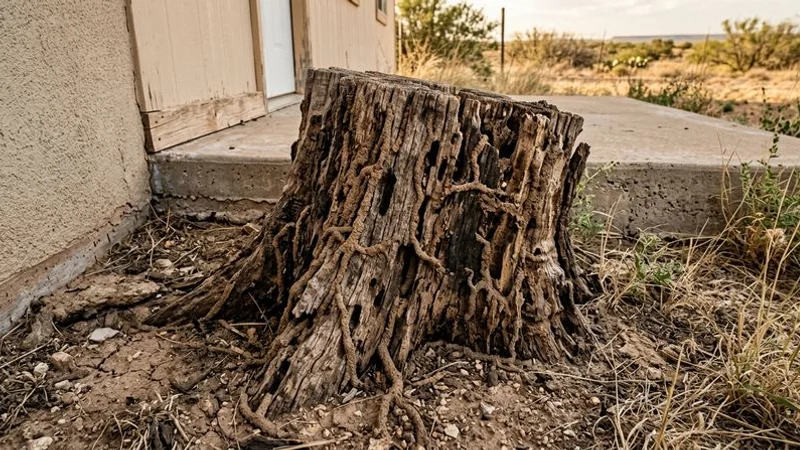
Carpenter ants represent another major concern for property owners dealing with old stumps. Our pest assessments show that unlike termites, these ants do not actually consume the wood. Instead, the Camponotus species excavates smooth galleries inside decaying wood to create large nesting spaces.
We often see piles of sawdust, known as frass, pushed out of small holes near the base of an infested tree stump. The softened, rotting wood provides an ideal environment for the queen to establish her primary parent colony. Our technicians track how these insects establish secondary bases inside nearby structures.
This is where the real danger lies for your home. We have seen foraging carpenter ants travel up to 100 yards from their main outdoor nest to build satellite colonies inside dry wall voids and window sills. Structural damage of this magnitude is incredibly serious, as a mature colony containing over 3,000 destructive ants can easily hollow out support beams. To catch an infestation early, you should look for several key indicators:
- Piles of fine wood shavings near baseboards or window sills.
- Faint rustling noises coming from inside hollow walls.
- Large winged ants emerging indoors during the spring months.
- Foraging trails extending from the yard directly to the foundation.
We recommend taking immediate action if you notice large black ants traveling in trails between an old stump and your house. In the Concho Valley, this pest pressure remains high from spring through fall.
Wood-Boring Beetles
Several species of wood-boring beetles are highly active across the region and actively seek out dead wood. Our specialists regularly encounter Redheaded Ash Borers and Lyctid powderpost beetles using dying stumps as breeding habitats. Female beetles deposit their eggs directly inside the wood pores of the stump.
We know that the resulting curved grubs, often called round-headed borers, tunnel relentlessly through the material as they develop. These grubs can spend several years inside the wood before finally emerging as adults. Our crews frequently spot the characteristic 1/16-inch shot holes on the surface of the wood as the adults exit.
While beetles colonizing outdoor stumps might seem harmless, they create a persistent threat to your property. We view an infested stump as a constant breeding ground that sends adult insects dispersing toward your home. This constant emergence significantly increases the chances of beetles invading stored lumber, firewood, or vulnerable hardwood floors inside your house.
The Threat to Indoor Wood
Our primary concern is that a stump infested with beetles becomes a staging area. Once adult beetles emerge, they readily migrate to other suitable wood sources. We strongly advise against keeping firewood anywhere near an old stump, as the beetles will easily bridge the gap.
Scorpions, Spiders, and Other Pests
Beyond wood-destroying insects, old stumps create prime real estate for a variety of West Texas wildlife. Our ground crews have to exercise extreme caution when removing stumps due to the dangerous pests hiding inside.
Scorpions
The striped bark scorpion (Centruroides vittatus) is the most widespread venomous scorpion in the state. We frequently find them sheltering under loose bark and in the cool soil around decaying root systems. A single striped bark scorpion can live for up to four years, using the stump as a staging area to escape high summer temperatures before eventually migrating into your living space.
Black Widows
Our teams treat every old stump as a potential black widow habitat. These venomous spiders favor dark spaces and build messy, tangled webs in the undisturbed cavities of rotting wood. We constantly find them concentrated around old wood debris throughout the Concho Valley.
Fire Ants
Red imported fire ants (Solenopsis invicta) frequently utilize the physical structure of a stump for their nests. Our landscapers note that these aggressive ants use the extensive, rotting root system as a deep anchor for their underground tunnels. Having a combined stump and fire ant mound in a yard where children play creates a severe safety hazard.
Rodents
We regularly partner with pest removal experts who find rats and mice using hollowed-out stumps as nesting sites. These rodents use the covered space to breed safely before seeking permanent shelter in your attic, garage, or crawl space.
Proximity to Structures: The Real Risk
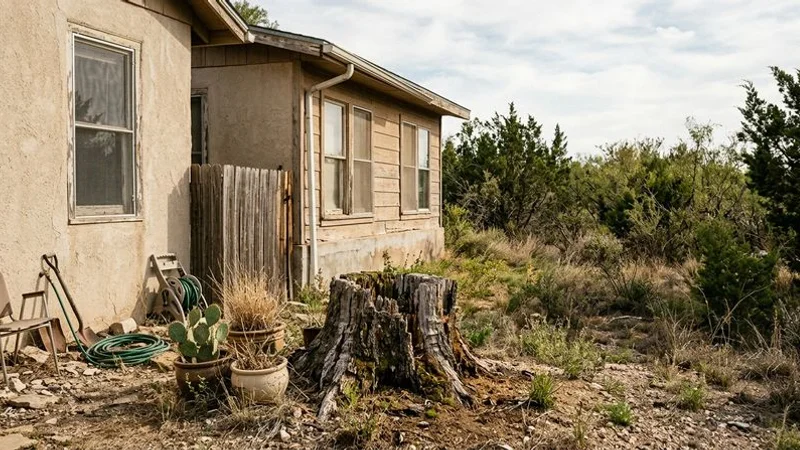
The specific danger an old stump poses depends entirely on its distance from your primary structures. Our standard risk assessment categorizes the threat into three distinct zones based on how easily pests can migrate.
Within 20 feet of your home
This close proximity creates an extremely high-risk scenario. We know that a termite colony can easily bridge this short distance with foraging tubes in just a few weeks. You must grind or remove this stump immediately to protect your foundation.
20 to 50 feet from your home
Our experience shows that stumps in this moderate risk zone still serve as excellent colony establishment points. Carpenter ants easily travel this distance to build satellite nests inside your wall voids. We strongly recommend removal here to eliminate the stepping stone pests use to reach your house.
More than 50 feet from your home
Stumps at this distance present a slightly lower immediate risk to the main house. Our experts advise removing them anyway, especially if you have outbuildings, wood fences, or decks nearby. Leaving them intact simply harbors a growing pest population that will eventually spread.
Prevention Through Stump Removal
The absolute most effective way to eliminate these pest risks is to remove the habitat entirely. Our company provides professional stump grinding as the most practical and cost-effective method for property owners. A heavy-duty grinder uses tungsten teeth to shred the above-ground wood and the upper root crown into fine mulch.
We highly recommend this service because it directly destroys the localized cellulose food source that termites crave. The financial benefit of preventative grinding becomes obvious when you compare the costs. Our analysis of 2026 industry data shows that standard stump grinding in the US averages around $250, while complex removal ranges from $120 to $400.
Compare that to the staggering $8,000 average cost for severe termite damage repairs and structural treatments. We can save you thousands in future pest control fees by simply addressing the stump right now.
| Service Type | Average 2026 Cost Range | Primary Benefit |
|---|---|---|
| Stump Grinding | $120 - $400 | Eliminates the pest habitat entirely before an infestation starts. |
| Standard Termite Treatment | $290 - $1,150 | Treats an active local infestation around the foundation perimeter. |
| Severe Termite Damage Repairs | $2,500 - $8,000+ | Required for severe structural infestations. |
Homeowners often ask us about the remaining underground roots. Decomposing roots dispersed through the soil are far less attractive to pests than one concentrated, above-ground mass of wood. Our arborists point out that ground-up roots lack the sheltered bark crevices necessary for nesting.
If you already have an active termite colony inside the stump, a pest control professional must treat the soil immediately after grinding. We ensure that the colony is fully eradicated rather than just pushed toward your home.
Signs Your Stump May Already Be Infested
You need to know exactly what to look for when inspecting your yard. Our technicians are trained to spot the subtle warning signs of active pest colonies during routine assessments. An insider tip from pest control professionals is to firmly tap the exterior of the stump with a screwdriver.
We find that a hollow, papery sound indicates extensive galleries hidden just beneath the surface. Watch carefully for these clear indicators:
- Mud tubes climbing the exterior of the stump or running across the soil toward your foundation.
- Sawdust-like frass accumulating in small piles around the base, signaling carpenter ants or beetles.
- Small 1/16-inch round exit holes on the wood surface left by emerging adult powderpost beetles.
- Active ant trails moving in organized lines between the dead wood and your house.
- Loose wood that breaks apart effortlessly when probed with a tool.
- Scorpions or spiders scattering when you peel back a section of loose bark.
Our strongest advice is to avoid delaying your response if you spot any of these signs. The longer a colony has to establish its numbers, the faster it will migrate to your home. We want to help you catch the problem before it requires expensive structural remediation.
Take Action Now
If you are still asking yourself, can old tree stumps attract termites and pests, the data provides a resounding yes. Our team views every month an old stump sits in your yard as another month for colonies to expand. Professional stump grinding offers a straightforward, affordable solution that eliminates this specific risk entirely.
We understand that pest pressure in the Concho Valley is a constant, year-round threat. Proactive removal is truly one of the smartest property investments you can make to protect your home. Our crews at San Angelo Texas Tree Service Pros are ready to help you reclaim your landscape.
Contact us today to schedule an assessment and get those dangerous stumps ground down safely and efficiently. We will eliminate the pest habitat so you can enjoy your yard with total peace of mind.
Tags: