When Is the Best Time to Trim Trees in San Angelo?
Discover the optimal times to trim and prune trees in San Angelo and West Texas. Learn species-specific timing, oak wilt prevention windows, and a seasonal pruning calendar for the Concho Valley.
You know how easily a beautiful landscape can turn into a massive headache if you make the wrong cut at the wrong time.
People constantly ask us, when is the best time to trim trees in San Angelo?
Timing serves as the absolute foundation of proper tree trimming and pruning because off-schedule cuts invite devastating infections like oak wilt. Our certified arborists want to share a comprehensive guide to proper pruning schedules for the West Texas climate.
The rules here have crucial regional nuances that every property owner should understand. Let’s look at the data behind dormant pruning, examine species-specific timelines, and lay out a clear seasonal plan for your property.
When Is the Best Time to Trim Trees in San Angelo? The Dormant Season
Our team follows a very simple baseline for most tree species in the Concho Valley. The ideal pruning window falls during the dormant season.
We recommend scheduling this quiet period from late December through mid-February. San Angelo sits in USDA Hardiness Zone 8a, where winter temperatures reliably drop between 10°F and 15°F during the coldest stretches.
These deep freezes force sap flow to slow down dramatically while the tree stores its energy safely in the root system. We prioritize dormant pruning for several critical, science-backed reasons:
- Reduced disease risk. Fungal pathogens and wood-boring insects remain inactive below 50 degrees.
- Better visibility. Stripped of foliage, the branching structure is fully visible to spot structural defects.
- Conserved energy. Making cuts now ensures the tree allocates its stored root reserves to explosive spring growth.
- Rapid compartmentalization. Wounds begin sealing almost immediately as soon as the weather warms up in March.
This approach prevents massive amounts of stress on the canopy. We also recognize that dormant pruning is not a universal rule.
Specific varieties like Live Oaks and Crepe Myrtles have strict timing requirements based on their unique biology.
Species-Specific Timing for San Angelo Trees
Live Oaks
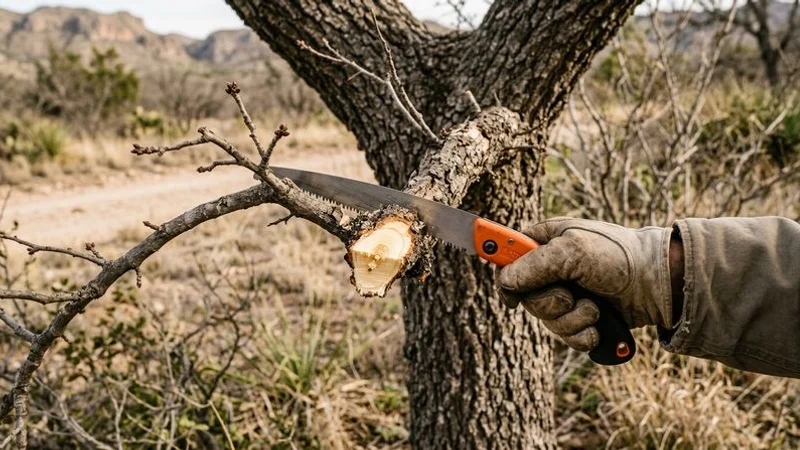
Live oaks represent the most valuable shade producers in San Angelo landscapes. Our crews strictly avoid pruning live oaks from February 1 through June 30.
This devastating fungal disease is spread by sap-feeding nitidulid beetles, which become highly active in Texas as soon as spring temperatures rise above 65°F.
Emergency Warning: If you face storm damage during the spring risk window, immediately paint any torn wood with Spectracide Pruning Seal or standard latex paint.
We schedule live oak maintenance from July through January to ensure absolute safety. The absolute ideal timeframe is mid-July through October when insect activity hits its lowest point of the year.
Pecan Trees
Pecans serve as the state tree of Texas and a common large shade producer in local neighborhoods. Our arborists trim pecans during late winter dormancy from January through mid-February before any buds break.
Timing dictates nut production success. We strongly advise against cutting pecans from April through September for three main reasons:
- Loss of Energy: Summer trimming steals the foliage the tree desperately needs for photosynthesis.
- Pest Vulnerability: Fresh cuts during the growing season expose the canopy to local pests like the Pecan Weevil (Curculio caryae). Texas A&M AgriLife Extension data shows these destructive weevils emerge from the soil starting in mid-August.
- Frost Damage: Late-season cuts trigger new, tender growth that will not harden off before the first frost hits Zone 8a.
Mesquite Trees
The Honey Mesquite tolerates trimming at almost any point in the year. We achieve the best results in San Angelo by handling them in late winter or early spring before they leaf out.
Removing excess, multi-trunk growth prevents the tree from becoming a giant sail. Our pruning strategy establishes a strong central leader to withstand the fierce 40 to 50 mph spring wind gusts frequently recorded by the National Weather Service in the Concho Valley.
Drought Warning: Avoid heavy canopy removal on mesquites during severe summer droughts. A water-stressed tree lacks the stored root reserves necessary to heal large wounds.
Red Oaks and Bur Oaks
Red oaks play a particularly dangerous role in the oak wilt cycle. We apply the exact same strict guidelines here as we do for live oaks.
These species act as the primary producers of the fruity-smelling fungal spore mats that attract disease-carrying beetles. Our teams never cut these trees from February through June.
An infected red oak has a near 100 percent mortality rate and can die in as little as 30 days.
Crepe Myrtles
Crepe myrtles provide incredible summer color throughout Tom Green County. We shape them in late winter before new growth begins, usually around February.
Proper care requires three specific, selective thinning cuts:
- Remove any dead or broken branches from the winter season.
- Cut away inward-growing branches that cross or rub against the main trunks.
- Trim off weak suckers sprouting from the base of the root crown.
We constantly see the harmful practice known as “crepe murder” in local landscaping. This butchery involves aggressively topping the tree back to thick, blunt stubs, which creates ugly, swollen knuckles.
Fruit Trees
Local orchards and backyard gardens thrive with peaches, plums, and figs. We prune these species in late January through mid-February while they are still asleep.
Making cuts right before spring growth begins promotes excellent vigor. Our selective thinning cuts focus on three specific goals:
- Opening up the center canopy for light penetration.
- Allowing crucial West Texas sunlight to reach interior branches for proper fruit ripening.
- Improving air circulation to cut down on brown rot during humid spells.
The Oak Wilt Risk Window in Texas
Oak wilt demands its own specific focus because it is rapidly destroying Central and West Texas canopies. We take this threat incredibly seriously to protect the local urban forest. Recent 2026 data from the Texas A&M Forest Service confirms the disease is active in 76 counties across the state, including Tom Green County.
Our company strictly observes the high-danger period spanning from February 1 through June 30. Nitidulid beetles are highly mobile during these warm spring months, and the fungus spreads aggressively underground.
We want property owners to know that once introduced, the Bretziella fagacearum fungus travels through interconnected oak root systems at a blistering average rate of 75 feet per year. Losing mature oaks causes property values to plummet by 15 to 20 percent, so you must follow these verified safety protocols during the risk window:
- Delay non-essential work. Never cut any oak species in the spring unless safety dictates it.
- Seal every wound. If emergency clearance is required, immediately paint the damaged wood with latex paint or commercial sealant.
- Sanitize your gear. Spray down loppers and chainsaws with a 10 percent bleach solution between cuts.
- Source firewood safely. Do not import unseasoned oak firewood from unknown sources.
- Watch for patterns. Report any suspicious activity, like multiple oaks dying in an expanding circle, directly to the Texas A&M Forest Service.
Emergency Pruning: Any Time Is the Right Time
There is one permanent exception to every seasonal guideline on the calendar. We perform immediate safety interventions when a fractured branch dangles over a roofline or a split trunk threatens a driveway.
Emergency tree service storm clearance acts as a regular necessity in the Concho Valley. Our teams handle the aftermath of severe spring thunderstorms that produce damaging straight-line winds. Winter occasionally drops heavy ice accumulations that overload and snap large limbs.
Safety First: Never attempt to clear large, storm-damaged branches near power lines on your own. Always rely on a certified professional equipped to follow ANSI A300 pruning safety standards.
We take extreme precautions when responding to oak damage during the spring risk window. Every single jagged tear or fresh chainsaw cut gets sealed immediately to guarantee no fungal infections spread.
A Seasonal Pruning Calendar for San Angelo
A visual guide makes planning your landscape maintenance much easier. We organized this specific timeline to help you schedule property care throughout the year.
Use this quick reference chart for the most common West Texas species.
| Season (Months) | Target Activity & Priority Species | Key Restrictions & Warnings |
|---|---|---|
| January to Mid-February | Prime dormant pruning. Schedule pecans, mesquites, elms, crepe myrtles, and fruit trees. | Wrap up all oak trimming before the weather warms. |
| March to May | Focus on non-oak species if needed. Address emergency storm damage. | HIGH OAK WILT RISK. Do not cut live or red oaks. |
| June to August | Light aesthetic maintenance only. Safe window for live oaks opens in July. | Avoid heavy canopy removal during peak 100-degree heat. |
| September to October | Ideal timeframe for oak maintenance. Great for structural assessments. | Do not prune pecans, as this interrupts nut development. |
| November to December | Trees enter full dormancy. Begin scheduling winter reductions. | Wait for all leaves to drop before doing structural cuts. |
Why Timing Matters for Your Trees
Making cuts at the wrong time causes a chain reaction of negative effects. We see how improper timing stunts the blooming cycles on ornamental varieties, ruins pecan harvests, and triggers weak shoot growth right before a freeze.
A stressed tree simply does not have the stamina to fight off infections or heal from improper cuts. Our team knows exactly how brutal the heat and drought cycles are on local landscapes.
Expert Tip: If you are still wondering when is the best time to trim trees in San Angelo, working with a certified arborist makes all the difference.
We schedule every job according to strict, species-specific best practices. San Angelo Texas Tree Service Pros is dedicated to providing high-quality tree care and arboriculture solutions for both residential and commercial properties.
Call our team today for a free consultation anywhere in Tom Green County and the Concho Valley.
Tags: