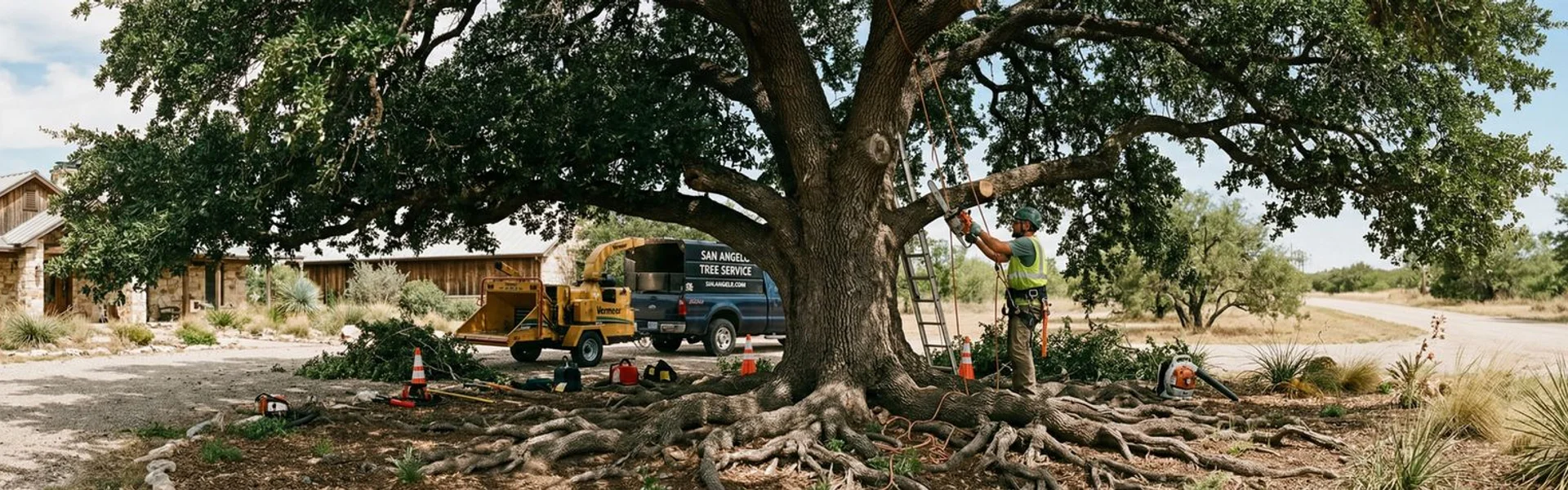
Non-Invasive AirSpade Root Excavation in San Angelo
AirSpade root excavation services in San Angelo, TX. Compressed air technology for non-destructive root investigation, girdling root correction, and construction damage assessment.
What's Included
- Non-destructive compressed air root excavation
- Girdling and circling root identification and removal
- Construction impact assessment and root mapping
- Root crown excavation for buried trunk flare
- Soil decompaction for compacted root zones
- Pre-construction root investigation and preservation
- Post-construction root damage evaluation
- Root zone aeration and soil amendment incorporation
Non-Destructive Root Investigation in San Angelo
Most tree problems start underground. By the time symptoms appear in the canopy — thinning foliage, early leaf drop, branch dieback, stunted growth — the root system has often been compromised for months or years. Traditional digging with shovels, trenchers, or backhoes to investigate these problems only makes them worse by cutting through the very roots the tree depends on for survival.
San Angelo Texas Tree Service Pros uses AirSpade compressed air excavation technology to expose tree roots without causing any damage. This allows our certified arborists to see exactly what is happening below ground, diagnose root-related problems accurately, and perform corrective treatments that give your trees the best chance of recovery. It is the most advanced diagnostic tool available in modern arboriculture, and we are one of the few tree service companies in the Concho Valley equipped to offer it.
How AirSpade Technology Works
The AirSpade is a pneumatic excavation tool powered by a high-volume air compressor. It delivers a precisely focused jet of compressed air at supersonic velocity through an engineered nozzle. When this air jet contacts soil, it fractures the bonds between soil particles and displaces them away from the excavation area.
The key to the technology is that tree roots are flexible, fibrous structures. The compressed air flows around them without causing damage. Soil, on the other hand, is a rigid matrix of mineral particles, organic matter, and pore spaces that fractures easily under the air jet’s force. This difference in physical properties allows the AirSpade to remove all the soil from around a root system while leaving every root — from large structural roots down to fine absorbing roots — completely intact.
In San Angelo’s soil conditions, which range from heavy clay to compacted caliche, the AirSpade is particularly valuable because these dense soils are nearly impossible to excavate by hand without severing roots. The air jet handles even the toughest caliche layers that resist conventional digging.
Common Applications in San Angelo
Root Crown Excavation
The root crown, also called the trunk flare, is the transition zone where the trunk widens and structural roots emerge. In a healthy tree, this flare should be visible at the soil surface. Unfortunately, many trees in San Angelo have been planted too deeply, had soil or mulch piled against their trunks, or had grade changes during construction that buried the root crown.
A buried root crown creates chronically wet conditions against the bark, promoting fungal decay at the most structurally critical point on the tree. It also hides girdling roots that may be forming below the soil surface. Root crown excavation with the AirSpade removes the excess material from around the trunk base, exposes the flare, and allows our arborist to assess the condition of the bark, cambium, and root attachments.
We recommend root crown excavation for any tree that shows a telephone-pole profile at the base — where the trunk goes straight into the ground without any visible flare. This is one of the most common and most correctable problems we find in San Angelo’s urban trees.
Girdling Root Correction
Girdling roots are roots that grow laterally around the trunk or over other roots rather than radiating outward from the tree. As these roots increase in diameter, they compress the bark and cambium of the trunk or the roots they cross, strangling the tree’s vascular system and structurally weakening the base.
Girdling roots are a leading cause of unexplained tree decline in San Angelo. They develop most commonly in trees that were container-grown before planting, especially if circling roots in the pot were not corrected at the time of planting. They can also form when roots encounter barriers like sidewalks, foundations, or compacted soil and are deflected back toward the trunk.
The AirSpade allows us to expose girdling roots completely so we can assess which roots are causing compression and which can be safely removed. Our arborist then uses sharp cutting tools to sever the offending roots at the appropriate location, relieving pressure on the trunk and allowing the tree to resume normal vascular function. The excavation is backfilled with quality soil and mulched to promote new root growth.
Pre-Construction Root Investigation
Construction projects near existing trees are one of the most common causes of tree loss in San Angelo. Trenching for utilities, excavating for foundations, grading for driveways, and compacting soil with heavy equipment all destroy roots and damage the growing environment that trees depend on.
We work with homeowners, builders, landscape architects, and civil engineers to investigate root locations before construction begins. Using the AirSpade, we expose the major structural roots within the planned construction zone and create a root map that allows the project team to route utilities, adjust grade plans, or modify building footprints to avoid critical root areas.
This proactive approach is far more effective and less expensive than trying to save a tree after construction damage has already occurred. Texas law protects certain heritage trees, and many San Angelo developments require tree preservation plans as a condition of permitting. Our root mapping services support compliance with these requirements.
Post-Construction Damage Assessment
When construction has already occurred near trees and decline symptoms appear, we use the AirSpade to evaluate the extent of root loss and damage. By exposing the root system, we can determine how many roots were severed, whether structural roots have been compromised, and whether the remaining root system is sufficient to support the tree long term.
This information is critical for making informed decisions about whether to invest in remedial treatment or proceed with removal. It also provides documentation for insurance claims, contractor disputes, and legal proceedings related to tree damage.
Soil Decompaction
Urban soils in San Angelo are frequently compacted by foot traffic, vehicle parking, construction activity, and the natural settling of fill material. Compacted soil restricts root growth, reduces water infiltration, and limits the oxygen exchange that roots need for healthy function. Trees growing in compacted soil often show symptoms of drought stress even when irrigation is adequate, because their roots cannot access the water that is present.
The AirSpade loosens compacted soil throughout the root zone without disturbing the roots themselves. We can then incorporate organic amendments, biochar, or structural soil mixes into the loosened material to improve long-term soil structure, drainage, and biological activity. This process, sometimes called vertical mulching or radial trenching, dramatically improves the growing environment for stressed trees.
Root Mapping for Tree Preservation
For large-scale development projects, tree preservation ordinance compliance, or high-value specimen trees, we provide detailed root mapping services. After AirSpade excavation, we document the location, direction, depth, and diameter of all major roots within the investigation area. This data is recorded on site plans and provided to the project team as a reference for protecting critical root infrastructure during construction.
Root mapping is also valuable for diagnosing complex decline situations where multiple trees share overlapping root zones, as is common with live oak mottes and pecan groves in Tom Green County. Understanding how root systems interact helps our arborists develop treatment plans that address the specific roots and soil conditions affecting each tree.
Protecting San Angelo’s Urban Forest Underground
The root system is the foundation of every tree’s health and structural stability. Problems that develop underground — girdling roots, compaction, buried root crowns, construction damage — are invisible from the surface but can slowly kill even the largest and most vigorous trees over a period of years. AirSpade root excavation gives our arborists the ability to see, diagnose, and treat these hidden problems without causing additional harm.
Contact San Angelo Texas Tree Service Pros to schedule a root zone evaluation. Whether you are troubleshooting an unexplained decline, planning a construction project near valuable trees, or simply want to verify that your trees are healthy below ground, our AirSpade services provide answers that no other diagnostic method can. We serve San Angelo, Grape Creek, Wall, Christoval, Ballinger, and communities throughout the Concho Valley.
Why Choose Us for Root Excavation
Zero Root Damage
Compressed air displaces soil particles without cutting or tearing roots, allowing us to expose the entire root system safely. No shovel, trencher, or backhoe can match this precision.
Accurate Root Zone Diagnosis
Many tree problems originate underground where they are invisible. AirSpade excavation lets our arborists see exactly what is happening at the root crown, structural roots, and absorbing root zone.
Construction Project Support
We work with builders, engineers, and landscape architects across San Angelo to map root locations before excavation, trenching, or grading begins, preventing costly tree loss during development.
Proven Technology
AirSpade tools have been used by arborists, utilities, and municipalities worldwide for over two decades. The technology is proven, reliable, and specifically engineered for working around tree roots.
Pricing
$400 - $1500 per project
Free estimates. Pricing varies by project scope.
Why Trust Us
- ISA Certified Arborist
- Fully Licensed & Insured
- 22+ Years Experience
- 5.0 Rating (100+ Reviews)
Related Services
Our Root Excavation Process
Site Evaluation
Our arborist assesses the tree, identifies symptoms of root problems, and determines the scope of excavation needed to diagnose and address the issue.
Utility Marking
We contact Texas 811 and verify all underground utility locations before beginning any excavation. Compressed air is safe for most utilities, but we confirm clearance as a precaution.
AirSpade Excavation
Using 90 to 150 PSI compressed air, we remove soil from the root zone without cutting, tearing, or damaging roots. Soil is displaced while roots remain intact and unharmed.
Diagnosis & Corrective Action
With roots exposed, our arborist identifies girdling roots, decay, damage, or other problems and performs corrective pruning or recommends treatment.
Backfill & Restoration
We backfill the excavation with amended soil or structural soil mix as appropriate, restore grade, and apply mulch to protect the treated root zone.
Root Excavation Gallery
What Clients Say About Our Root Excavation
“We were losing a 40-year-old pecan and nobody could figure out why. The AirSpade excavation revealed three massive girdling roots strangling the trunk underground. They removed the roots and the tree has been recovering beautifully. Technology I did not even know existed.”
Michael Chen
“Our contractor was about to trench right through our heritage live oak's root zone for a new water line. San Angelo Tree Service Pros came out with the AirSpade, mapped the major roots, and the contractor was able to route around them. Saved our tree.”
Sarah Whitfield
Root Excavation FAQs
An AirSpade is a specialized pneumatic tool that uses a supersonic air jet to fracture and displace soil particles without damaging tree roots, utility lines, or other underground structures. Compressed air at 90 to 150 PSI is directed through a precisely engineered nozzle that breaks the bond between soil particles. Roots are flexible and fibrous, so the air flows around them while the rigid soil is blown away. This allows us to expose the entire root system for inspection, diagnosis, and treatment without any of the cutting or tearing damage caused by mechanical digging.
Common reasons include diagnosing unexplained decline in an otherwise healthy-looking tree, identifying girdling roots that are strangling the trunk below grade, evaluating root damage from nearby construction, exposing a buried root flare that has been covered by soil or mulch, and mapping root locations before construction begins. If your tree is declining and above-ground inspection has not revealed a cause, the problem is very likely underground.
Compressed air is the safest excavation method near utilities. The air cannot cut through pipe, conduit, or cable the way a shovel or backhoe can. We still contact Texas 811 before every job to verify utility locations and take appropriate precautions, but the AirSpade's non-destructive nature makes it the preferred tool for excavation near underground infrastructure.
A typical root crown excavation on a single tree takes two to four hours depending on the tree's size and soil conditions. San Angelo's caliche soils can be harder to excavate than loamy soils, which may extend the timeline. Larger projects involving root mapping for construction or multiple trees may take a full day or more. We provide time and cost estimates after the initial site evaluation.
Yes. The AirSpade uses compressed air to move soil without cutting or damaging roots. Unlike mechanical excavation with shovels or backhoes, the air stream passes around roots without harming them. This makes it the safest method for root zone work on valuable trees.
Ready for Professional Root Excavation?
Contact our ISA Certified Arborist team for a free estimate on root excavation in San Angelo and Tom Green County.